Table of Contents
- Introduction: Navigating the Methodology Maze
- Agile Methodology: Core Principles for PMs
- DevOps Philosophy: Bridging Development and Operations
- Site Reliability Engineering (SRE) Explained
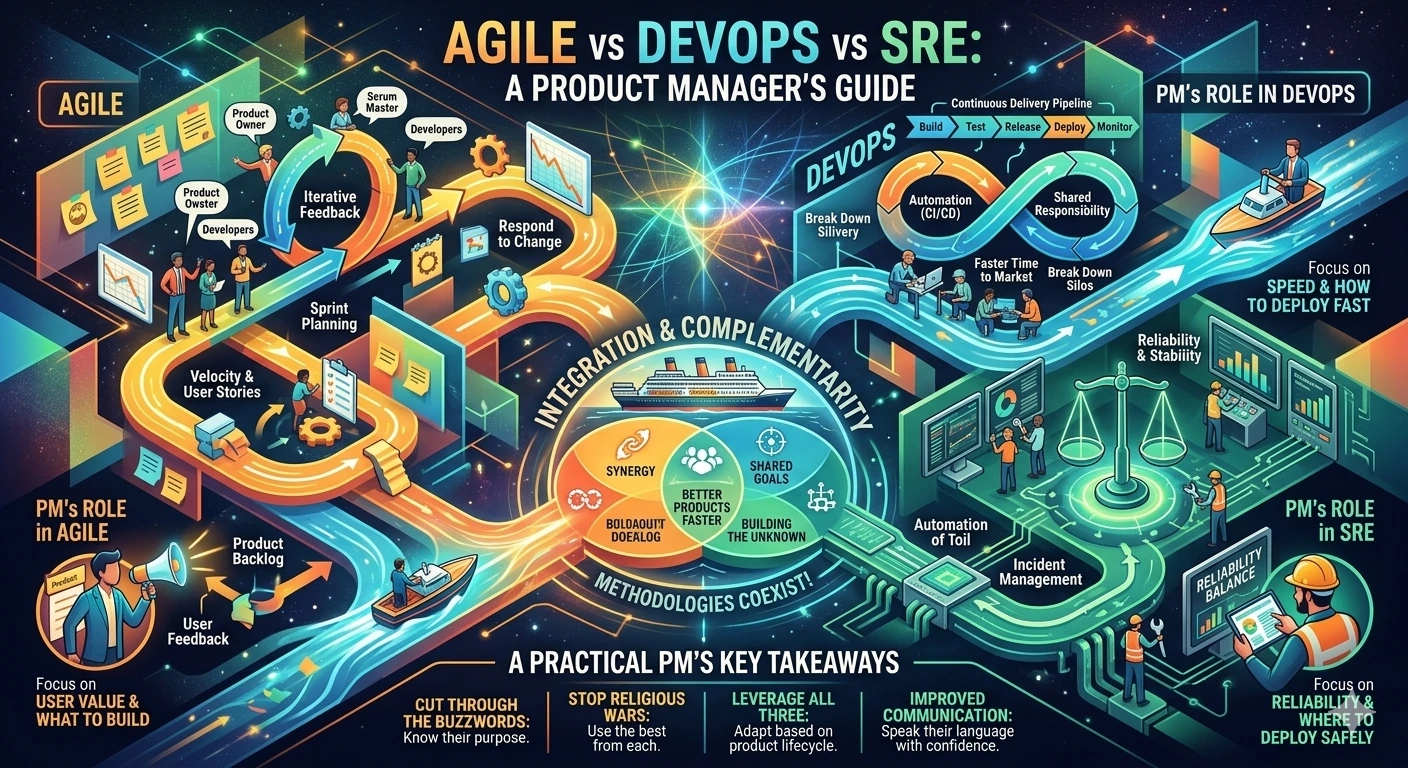
- How These Methodologies Complement Each Other
- The Product Manager’s Role in Each
- Common Misconceptions and Pitfalls
- Choosing the Right Approach for Your Team
- Implementation Checklist
- Conclusion: Integration Over Competition
Introduction: Navigating the Methodology Maze
Picture this: You’re in a meeting with your engineering team, and someone mentions they need to “align the sprint with DevOps practices while maintaining SRE principles for incident management.” Your VP nods knowingly. Your CTO adds something about “error budgets affecting our Agile velocity.” And you? You’re sitting there wondering if everyone else took a secret class you missed.
Here’s the naked truth: most people in that room are also confused. They’ve just gotten better at nodding.
The software development landscape has become a battlefield of buzzwords. Agile. DevOps. SRE. Platform Engineering. Everyone claims their methodology is the answer. Teams fight religious wars over which approach is “correct.” Meanwhile, you—the Product Manager—are caught in the crossfire, trying to understand how any of this helps you ship better products faster.
This guide cuts through the noise.
We’re going to break down each methodology honestly, explain how they actually work together (spoiler: they’re not competitors), and show you exactly what your role should be in each. No jargon. No academic theory. Just practical insights from someone who’s seen these methodologies succeed and fail in the real world.
By the end of this article, you’ll not only understand the differences—you’ll know how to leverage all three to build better products. Let’s dive in.
Agile Methodology: Core Principles for PMs
Let’s start with the grandfather of modern software development methodologies. Agile isn’t a process—it’s a mindset. And that distinction matters more than you might think.
What Agile Actually Is
Agile emerged in 2001 when seventeen software developers gathered at a ski resort in Utah and produced the Agile Manifesto. The document was short—just four values and twelve principles—but it fundamentally changed how we think about building software.
The four core values:
- Individuals and interactions over processes and tools
- Working software over comprehensive documentation
- Customer collaboration over contract negotiation
- Responding to change over following a plan
Notice what’s emphasized and what’s de-emphasized. Agile doesn’t say documentation is worthless—it says working software matters more. It doesn’t say planning is useless—it says responding to change matters more.
The PM’s Relationship with Agile
As a Product Manager, Agile is probably where you spend most of your time. User stories. Sprint planning. Backlog refinement. Retrospectives. These are your daily bread and butter.
But here’s where many PMs go wrong: they confuse Agile rituals with Agile principles.
Standing in a circle for a daily standup doesn’t make you Agile. Neither does using Jira, or having two-week sprints, or calling your requirements “user stories.” Agile is about iterative delivery, continuous feedback, and adaptability.
The Naked Truth: If your team spends more time discussing story points than delivering value to customers, you’re doing Agile wrong. The methodology serves the product, not the other way around.
Key Agile Practices That Matter for PMs
1. Sprint Planning with Purpose
Every sprint should answer one question: “What’s the most valuable thing we can ship in this timeframe?” Your job isn’t to fill capacity—it’s to maximize value delivery. That might mean shipping one feature instead of five if that one feature moves the needle.
2. Backlog Management as Strategy
Your backlog is your product strategy made visible. A messy, unprioritized backlog isn’t an administrative problem—it’s a strategic failure. Every item should have a clear rationale for its position.
3. Retrospectives as Continuous Improvement
Don’t let retrospectives become complaint sessions. Focus on actionable improvements. If the same issue comes up three retrospectives in a row, you’re not taking action fast enough.
4. Accepting That Agile Isn’t Always the Answer
Some projects genuinely benefit from more structured approaches. Compliance-heavy features, safety-critical systems, or projects with fixed deadlines and fixed scope might need different handling. Agile is a tool, not a religion.
The Agile Anti-Pattern
Here’s something they don’t teach in Agile training: many teams claiming to be Agile are actually doing “Wagile” or “Fragile.”
- Wagile: Waterfall disguised as Agile. You plan everything upfront, execute in sprints, but never adjust based on learning.
- Fragile: So afraid of process that nothing gets documented, creating chaos and dependency on tribal knowledge.
As a PM, your job is to keep the team honest about whether they’re actually living Agile values or just performing Agile rituals.
DevOps Philosophy: Bridging Development and Operations
If Agile is about how you build software, DevOps is about how you deliver and operate it.
The Problem DevOps Solved
Before DevOps, development and operations were separate worlds with opposing incentives:
- Developers were measured on feature delivery. Their goal was to ship code fast.
- Operations was measured on stability. Their goal was to never let anything break.
These incentives were fundamentally at odds. Developers threw code over the wall to operations, who then bore the burden of keeping it running. Operations responded by creating bureaucratic gates to slow down changes. The result? Slower delivery, more bugs, and constant finger-pointing.
Sound familiar? If you’ve ever heard “it works on my machine” from a developer, you’ve seen this divide in action.
DevOps as Cultural Transformation
DevOps isn’t about tools. It’s not about CI/CD pipelines or infrastructure as code—though those things help. DevOps is fundamentally a cultural shift.
The core DevOps principles:
- Break down silos: Developers and operations work together, not separately.
- Share responsibility: The team that builds it runs it. No more throwing code over the wall.
- Automate everything: Manual processes are slow and error-prone. Automate builds, tests, deployments, and infrastructure.
- Continuous feedback: Learn from production quickly and iterate.
The CAMS Model
Patrick Debois, often called the “father of DevOps,” and others articulated the CAMS model:
- Culture: Breaking down walls between teams
- Automation: Removing manual toil
- Measurement: Data-driven decisions
- Sharing: Open communication and collaboration
As a Product Manager, you need to understand how each of these affects your product’s delivery.
DevOps Practices That Impact Your Product
1. Continuous Integration/Continuous Delivery (CI/CD)
Every code change is automatically built, tested, and prepared for deployment. This means faster feedback loops and the ability to ship to production multiple times per day if needed.
What this means for you: Feature delivery isn’t blocked by release calendars. You can ship when features are ready, not when IT schedules a release window.
2. Infrastructure as Code (IaC)
Servers, databases, and infrastructure are defined in code and version-controlled. This means reproducible environments and faster environment provisioning.
What this means for you: New environments for testing, staging, or new features can be spun up in minutes, not weeks.
3. Monitoring and Observability
DevOps teams invest heavily in understanding system behavior. Logs, metrics, and traces provide visibility into how the product performs in production.
What this means for you: Better data on feature performance, user behavior, and issues. You can make decisions based on real production data, not assumptions.
The Naked Truth: If your engineering team says “we can’t give you that data” or “we don’t know how users are using that feature,” you have an observability problem. That’s a DevOps issue you need to champion.
Where DevOps and Agile Intersect
Here’s the key insight: DevOps extends Agile principles to operations.
Agile says: Ship working software frequently. DevOps says: Here’s how you do that safely and reliably.
Agile says: Respond to change quickly. DevOps says: Here’s how you build systems that allow rapid, safe changes.
They’re not competing methodologies—they’re complementary approaches that work together. Agile focuses on the “what” and “why” of product development. DevOps focuses on the “how” of delivery and operations.
Site Reliability Engineering (SRE) Explained
Now we come to the newest and most misunderstood methodology: Site Reliability Engineering.
The Google Origin Story
SRE was born at Google in the early 2000s. The company was growing fast, and traditional operations approaches couldn’t keep up. Ben Treynor Sloss, who led Google’s production environment team, asked a radical question: What if we treated operations as a software engineering problem?
The result was SRE: applying software engineering principles to infrastructure and operations problems.
What SRE Actually Means
SRE is a job function and a set of practices, not just a methodology.
SREs are engineers who build and maintain systems that keep products running. But unlike traditional operations engineers, SREs focus on building automation and tooling to reduce manual work.
The key SRE principles:
1. Error Budgets
This is perhaps the most important SRE concept for Product Managers. An error budget is the acceptable amount of unreliability for a service.
For example, if your SLA (Service Level Agreement) promises 99.9% uptime, you have an error budget of 0.1% downtime per year. That’s about 8.76 hours of acceptable downtime.
Error budgets create a shared language between product and engineering. Instead of reliability being an absolute (“we can never have downtime”), it becomes a business decision. If you’ve used up your error budget, maybe you should focus on stability instead of new features.
2. Service Level Objectives (SLOs)
SLOs define target reliability levels. They’re the goals you set for your service’s behavior.
Common SLOs:
- 99.9% of requests succeed within 200ms
- 99.5% uptime during business hours
- Data loss events fewer than once per year
As a PM, you should understand your product’s SLOs. They directly impact user experience and set expectations for what “good” looks like.
3. Eliminating Toil
SREs define “toil” as manual, repetitive work that doesn’t create enduring value. Applying a security patch to 100 servers manually? Toil. Writing a script that applies patches automatically? Engineering.
SRE’s goal is to keep toil under 50% of the team’s time. The rest should go toward engineering work that reduces future toil.
4. Blameless Post-Mortems
When incidents happen, SREs focus on understanding why, not who to blame. This psychological safety enables honest learning and prevents future issues.
SRE vs. DevOps: The Key Differences
Many people treat SRE and DevOps as competitors. They’re not. They’re different approaches to similar problems.
| Aspect | DevOps | SRE |
|---|---|---|
| Focus | Culture and collaboration | Engineering practices |
| Approach | Break down silos | Apply software engineering to ops |
| Measurement | DORA metrics | Error budgets and SLOs |
| Team Structure | Combined dev and ops teams | Dedicated SRE team (or embedded) |
| Background | Dev and ops professionals | Software engineers |
The Naked Truth: If your team is debating whether to “do DevOps or SRE,” they’re asking the wrong question. These aren’t mutually exclusive. You can have DevOps culture AND SRE practices.
When SRE Makes Sense
SRE isn’t right for every team. It works best when:
- Your product has significant reliability requirements
- You have engineering capacity to invest in reliability tooling
- Your scale justifies dedicated reliability focus
A startup with three engineers probably doesn’t need a dedicated SRE team. But a fintech processing millions in daily transactions? Absolutely.
How These Methodologies Complement Each Other
Here’s where everything comes together. Agile, DevOps, and SRE form a complete approach to building and running software products.
The Three-Layer Model
Think of these methodologies as layers that build on each other:
Layer 1: Agile (Product & Planning)
- Focus: What to build and why
- Key questions: What do users need? What’s valuable? How do we iterate?
- PM’s role: Strategic direction, prioritization, stakeholder communication
Layer 2: DevOps (Delivery & Operations)
- Focus: How to build and deploy efficiently
- Key questions: How do we ship quickly? How do we collaborate? How do we automate?
- PM’s role: Understanding delivery capabilities, removing blockers, championing automation
Layer 3: SRE (Reliability & Scale)
- Focus: How to keep it running reliably
- Key questions: How reliable is reliable enough? What’s our error budget? How do we respond to incidents?
- PM’s role: Setting reliability expectations, making error budget tradeoffs, participating in post-mortems
A Practical Example
Let’s say you’re launching a new checkout flow for an e-commerce product:
Agile practices help you:
- Break the checkout redesign into small, shippable increments
- Get user feedback early through A/B testing
- Adjust priorities based on what you learn
DevOps practices help you:
- Deploy the new checkout safely alongside the old one
- Monitor real-time performance and user behavior
- Roll back quickly if something goes wrong
SRE practices help you:
- Define reliability targets for checkout (e.g., 99.99% success rate)
- Monitor error budgets as you make changes
- Respond effectively to payment processing issues
Each methodology contributes something essential. Without Agile, you might ship the wrong thing. Without DevOps, you might ship slowly or unreliably. Without SRE, you might break existing functionality while adding new features.
The Integration Challenge
Here’s the hard part: these methodologies are often owned by different teams with different incentives.
- Product Management typically owns Agile practices
- Engineering typically owns DevOps practices
- SRE team (if you have one) owns reliability practices
This creates potential conflicts:
- Product wants faster feature delivery (Agile)
- DevOps wants stable release processes (DevOps)
- SRE wants reliability over new features (SRE)
The solution? Shared metrics and shared language.
Error budgets create a common language for reliability vs. velocity tradeoffs. DORA metrics (Deployment Frequency, Lead Time for Changes, Time to Restore Service, Change Failure Rate) create common measures of delivery performance. User value metrics create common goals for product success.
The Product Manager’s Role in Each
Now let’s get practical. What exactly should you be doing in each methodology?
Your Role in Agile
You’re probably most comfortable here. Your Agile responsibilities include:
1. Backlog Ownership
The product backlog is your responsibility. You decide what’s important and why. But “ownership” doesn’t mean working in isolation—it means facilitating decisions, gathering input, and making the final call.
2. Sprint Goal Definition
Every sprint should have a clear goal. Not just “complete these stories” but “deliver this outcome.” Your job is to articulate that goal in terms of user value.
3. Stakeholder Communication
You’re the bridge between the team and stakeholders. You translate business needs into user stories and sprint progress into business updates.
4. Continuous Learning
Agile is about adapting. Your job is to bring insights from users, analytics, and stakeholders back to the team so they can adjust.
Your Role in DevOps
DevOps might feel like “engineering territory,” but you have important responsibilities:
1. Champion Automation
Manual processes slow everything down. Question any process that involves manual steps. Ask “can this be automated?” constantly.
2. Understand Delivery Pipeline
You should know how code gets from commit to production. Not at a technical level, but at a process level. Where are the bottlenecks? What takes the longest? Understanding this helps you set realistic expectations and prioritize improvements.
3. Advocate for Observability
You need data to make good decisions. If you can’t get answers about feature usage, performance, or issues, advocate for better observability tools and practices.
4. Support “You Build It, You Run It”
The most powerful DevOps principle is that teams own their code in production. This might mean adjusting your expectations—teams might need time for operational work that doesn’t produce new features.
Your Role in SRE
SRE requires the most active participation from Product Managers:
1. Define and Own SLOs
Service Level Objectives should come from product requirements, not just technical constraints. What level of reliability do your users need? What’s acceptable downtime? You should lead these conversations.
2. Make Error Budget Decisions
When error budgets are exhausted, someone needs to decide: do we stop shipping new features and focus on reliability? That’s a product decision, not an engineering decision. You need to be ready to make it.
3. Participate in Post-Mortems
When incidents happen, you should be in the post-mortem. Not to assign blame, but to understand the product impact and communicate with stakeholders. You might also identify product changes that could prevent future incidents.
4. Balance Innovation and Reliability
SREs naturally bias toward reliability. You naturally bias toward innovation. Both are necessary. Your job is to find the right balance.
The Naked Truth: If your engineering team is making reliability tradeoffs without product input, you’re not doing your job. Reliability is a product feature, not just a technical concern.
Common Misconceptions and Pitfalls
Let’s address some myths that cause real problems:
Misconception 1: “We Need to Pick One Methodology”
The Reality: You don’t choose between Agile, DevOps, and SRE. You use all of them for different purposes. Asking “should we do Agile or DevOps?” is like asking “should we plan or execute?” You need both.
Misconception 2: “DevOps Replaces Agile”
The Reality: DevOps extends Agile principles to operations. It doesn’t replace Agile. Many of the most effective teams use Agile for product development and DevOps for delivery.
Misconception 3: “SRE Is Just Operations With a New Name”
The Reality: SRE applies software engineering to operations problems. Traditional ops manages servers. SREs build systems that manage servers. The mindset is fundamentally different.
Misconception 4: “These Methodologies Fix Bad Teams”
The Reality: No methodology fixes fundamental problems like poor leadership, lack of trust, or unclear goals. Methodology amplifies culture—it doesn’t replace it.
Misconception 5: “SRE Is Only for Large Companies”
The Reality: SRE principles apply at any scale. A startup can set SLOs, track error budgets, and run blameless post-mortems. You don’t need a dedicated SRE team to adopt SRE thinking.
The Biggest Pitfall: Cargo Culting
The term “cargo cult” comes from Pacific Islanders who, after seeing cargo planes bring supplies during World War II, built fake runways and control towers hoping to attract more planes. They copied the form without understanding the function.
Many teams do this with methodologies.
They adopt standups, sprints, and retrospectives because “that’s what Agile teams do.” They implement CI/CD pipelines because “that’s what DevOps teams do.” They track SLIs and SLOs because “that’s what SRE teams do.”
But they don’t adopt the underlying principles. The rituals remain hollow, and the benefits never materialize.
The Naked Truth: If your methodology isn’t delivering results, don’t add more process. Ask whether you’re solving the right problems. A standup that doesn’t surface blockers is just a status meeting. A retrospective that doesn’t lead to change is just a complaint session.
Choosing the Right Approach for Your Team
Every team is different. Here’s how to think about what works for yours:
Assess Your Current State
Before adopting any methodology, understand where you are:
- Delivery Speed: How often do you ship to production? Daily? Weekly? Monthly? Quarterly?
- Reliability: What’s your uptime? How often do you have incidents?
- Collaboration: How well do development and operations work together?
- Visibility: Can you answer questions about how your product performs in production?
Be honest. This isn’t about looking good—it’s about identifying opportunities.
Start With Pain Points
Don’t adopt methodologies because they’re popular. Adopt them because they solve real problems.
If your pain point is unclear priorities or slow adaptation to feedback:
- Focus on Agile practices
- Start with better backlog management and sprint goals
- Invest in user research and feedback loops
If your pain point is slow or risky releases:
- Focus on DevOps practices
- Start with CI/CD and automated testing
- Invest in release automation and rollback capabilities
If your pain point is reliability or frequent outages:
- Focus on SRE practices
- Start with defining SLOs and error budgets
- Invest in monitoring, alerting, and incident response
Scale Appropriately
A team of five engineers doesn’t need the same practices as a team of 500.
For small teams:
- Keep processes lightweight
- Combine roles (one person might handle DevOps and SRE concerns)
- Focus on fundamentals over sophisticated tooling
For large teams:
- Invest in dedicated roles and teams
- Build more sophisticated automation and tooling
- Create clear interfaces between teams
Iterate on Process
Here’s a principle from Agile that applies to methodology adoption itself: start small and iterate.
Don’t try to implement every Agile ceremony, DevOps practice, and SRE principle at once. Pick one thing, do it well, and expand from there. Let your process evolve based on what works for your team.
Implementation Checklist
Ready to put these ideas into action? Here’s a practical checklist:
Agile Implementation
- Define clear sprint goals that articulate user value
- Clean up your backlog—remove stale items, ensure remaining items have clear value statements
- Make retrospectives actionable—track whether changes actually happen
- Establish regular user feedback loops
- Review your estimation process—is it serving your needs?
DevOps Implementation
- Map your deployment pipeline—identify every step from commit to production
- Question every manual step in your process
- Ensure you have basic monitoring in place for critical user journeys
- Establish a rollback process for every deployment
- Create feedback loops between production and development
SRE Implementation
- Define SLOs for your most critical user journeys
- Calculate your current error budget consumption rate
- Run a blameless post-mortem for your most recent incident
- Identify your top sources of toil and prioritize automation
- Create an incident response playbook
Integration
- Share your SLOs with stakeholders
- Include reliability metrics in your regular reporting
- Make error budget status visible in sprint planning
- Ensure post-mortem learnings feed into your backlog
- Create shared metrics across teams
Conclusion: Integration Over Competition
Let’s return to that confusing meeting where someone mentioned “aligning sprints with DevOps practices while maintaining SRE principles.”
Now you know: that sentence isn’t nonsense. It’s describing how these methodologies work together.
Agile sprints deliver value incrementally. DevOps practices ensure those increments can be shipped safely and frequently. SRE principles ensure the product stays reliable as you ship.
These aren’t competing philosophies. They’re complementary practices.
As a Product Manager, your job isn’t to pick one methodology and defend it religiously. Your job is to understand how all three contribute to building great products—and to help your team integrate them effectively.
The teams that succeed aren’t the ones who follow Agile or DevOps or SRE most strictly. They’re the ones who understand the principles behind these methodologies and adapt them to their unique context.
The Naked Truth: Methodology is means, not end. The goal is delivering value to users through reliable software. If Agile, DevOps, and SRE practices help you do that, use them. If they don’t, question them. Your job isn’t to be Agile, DevOps, or SRE-compliant. Your job is to ship great products.
Stop treating methodologies like sports teams to root for. Start treating them like tools in your toolkit. Use the right tool for the job, and don’t be afraid to build your own approach.
Ready to dive deeper into DevOps practices? Check out my DevOps for Product Managers: The Complete 2025 Update for the latest on how DevOps is evolving and what it means for your product strategy.
About the Author
Karthick Sivaraj is the founder of The Naked PM blog and a seasoned Product Manager who’s navigated the methodology maze at companies ranging from early-stage startups to Fortune 500 enterprises. He believes in cutting through buzzwords to find what actually works. Connect with him on LinkedIn or Twitter for more honest takes on product management and DevOps.
💬 Join the Conversation