Table of Contents
- Introduction: What Changed in 2026
- The Current State of DevOps
- Platform Engineering: The New DevOps Backbone
- AI-Native DevOps: What PMs Need to Know
- DevOps Metrics Evolution
- Security Shifts: DevSecOps for PMs
- Cloud Native Changes Product Managers Should Understand
- Working with Modern DevOps Teams
- DevOps Tools Landscape 2026
- Your DevOps Action Plan for 2026
Introduction: What Changed in 2026
If you learned DevOps a few years ago, the way teams operate today may look very different.
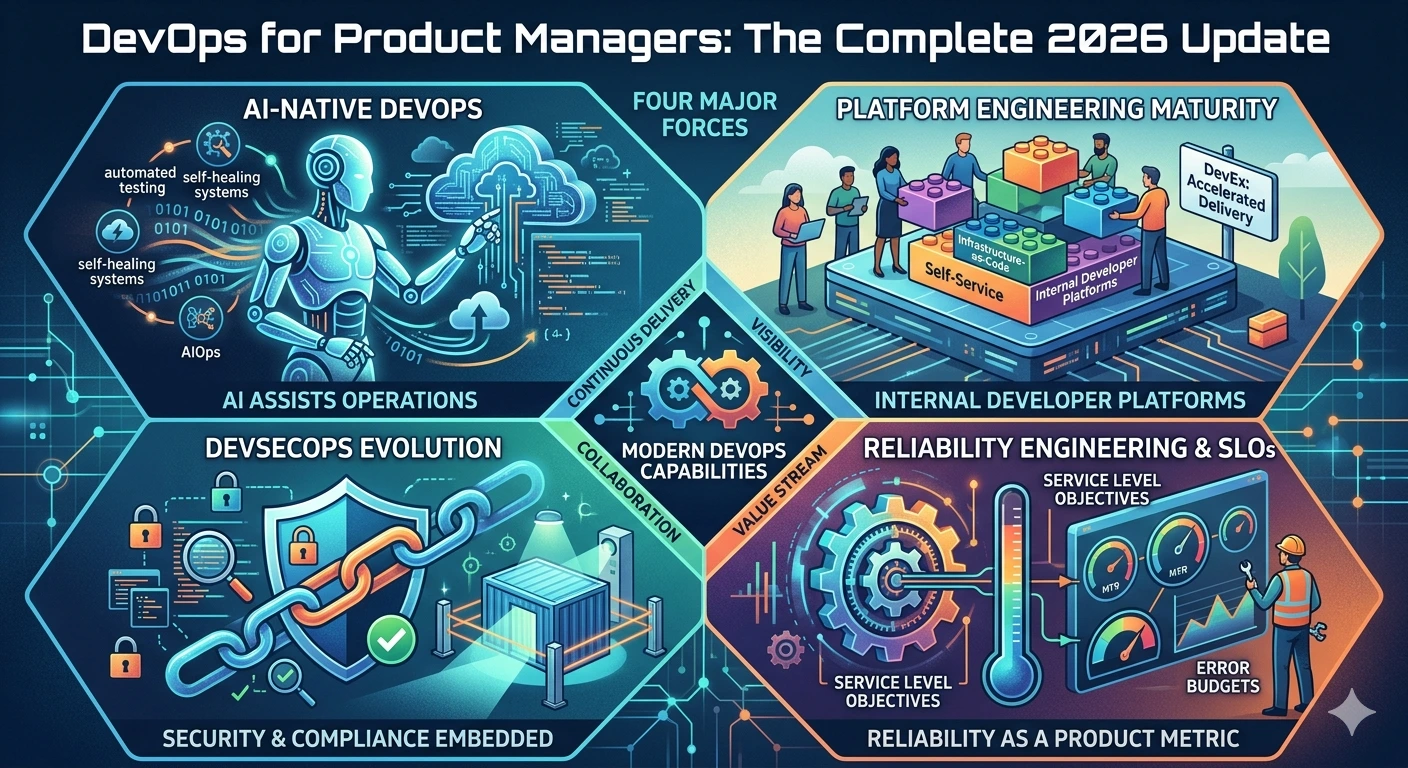
DevOps in 2026 is no longer just about CI/CD pipelines or developers collaborating with operations teams. It has evolved into a complete product delivery system powered by platforms, AI, and reliability engineering.
Most organizations today don’t even talk about “doing DevOps.” Instead, they focus on capabilities like:
- Internal developer platforms
- AI-assisted operations
- developer experience (DevEx)
- reliability engineering and SLOs
DevOps practices are now so embedded in engineering culture that they function more like infrastructure for building software organizations.
The Naked Truth: DevOps stopped being a “team practice” and became an organizational capability. The companies winning in 2026 treat DevOps as product infrastructure, not engineering overhead.
Four major forces are shaping DevOps today.
Platform Engineering became the default
Platform engineering has moved from an emerging trend to the standard operating model for engineering teams.
Instead of every team managing infrastructure and pipelines themselves, platform teams build internal developer platforms that provide self-service tools.
Developers consume these capabilities rather than building them from scratch.
AI moved from assistant to co-pilot
AI tools now support the entire development lifecycle:
- generating infrastructure configurations
- analyzing logs and telemetry
- detecting anomalies
- assisting incident response
- summarizing outages
AI doesn’t replace engineers, but it significantly increases their productivity.
Security became embedded everywhere
Security is no longer a gate at the end of development.
Modern pipelines integrate security scanning directly into:
- code commits
- builds
- container images
- runtime environments
Security has become part of the development workflow.
Developer experience became a strategic priority
Companies increasingly recognize that developer productivity drives product velocity.
Improving developer experience—reducing friction, simplifying environments, and improving tooling—has become a major focus of modern DevOps practices.
The Current State of DevOps
Organizations today fall into different levels of DevOps maturity.
Level 1: Traditional
Some companies still operate with traditional models.
Characteristics include:
- manual deployments
- separate development and operations teams
- infrequent releases
- high failure rates
Level 2: Emerging
These teams have started adopting DevOps practices.
Typical characteristics:
- basic CI/CD pipelines
- partial automation
- improved collaboration
- more frequent releases
Level 3: Mature
At this stage organizations have implemented most core DevOps capabilities.
Common features include:
- robust CI/CD pipelines
- infrastructure as code
- automated testing
- observability systems
- frequent deployments
Level 4: Advanced
Advanced DevOps organizations typically operate with:
- internal developer platforms
- strong observability practices
- automated deployments
- self-service infrastructure
- integrated security practices
Level 5: Leading
The most advanced organizations in 2026 operate with AI-assisted DevOps systems, where much of the operational workload is automated.
Capabilities include:
- predictive incident detection
- autonomous remediation for common issues
- AI-assisted debugging
- advanced reliability engineering
Platform Engineering: The New DevOps Backbone
One of the biggest changes in DevOps over the past few years is the rise of platform engineering.
Platform engineering treats internal infrastructure as a product built for developers.
Instead of requiring every team to understand complex operational systems, platform teams build tools that provide standardized capabilities.
These platforms typically include:
- self-service infrastructure provisioning
- standardized CI/CD pipelines
- observability tools
- developer portals
- automated environment creation
The goal is simple:
reduce cognitive load for developers so they can focus on building products.
From a Product Manager perspective, this shift has several implications.
Platform teams often operate like product teams themselves, maintaining roadmaps and prioritizing developer needs.
Product teams consume the platform as customers.
Understanding platform capabilities helps PMs:
- estimate delivery timelines more accurately
- avoid unnecessary infrastructure work
- ship features faster
AI-Native DevOps: What PMs Need to Know
AI has become deeply integrated into DevOps workflows.
This shift is sometimes referred to as AI-native DevOps.
AI systems now assist in multiple parts of the development lifecycle.
AI-assisted development
Developers increasingly rely on AI tools to generate code, documentation, and infrastructure configurations.
This accelerates development but also introduces new challenges around code review and validation.
Intelligent monitoring
Modern observability systems use machine learning to detect anomalies and correlate events across distributed systems.
This reduces alert fatigue and surfaces issues earlier.
Automated incident response
AI systems can now assist during outages by:
- analyzing logs
- identifying potential root causes
- recommending remediation steps
- generating incident summaries
These capabilities help engineering teams resolve issues faster.
The Naked Truth: AI doesn’t eliminate operational complexity. It simply allows teams to manage more complex systems with fewer people.
DevOps Metrics Evolution
Metrics remain central to DevOps practices.
The DORA metrics continue to serve as the industry standard for measuring delivery performance.
These include:
- deployment frequency
- lead time for changes
- mean time to recovery
- change failure rate
High-performing teams in 2026 typically deploy multiple times per day and recover from incidents within minutes.
In addition to DORA metrics, many organizations now track developer experience metrics, including:
- time to first successful build
- deployment friction
- tool satisfaction
- onboarding time for new developers
These metrics help organizations understand how engineering environments affect productivity.
Security Shifts: DevSecOps for PMs
Security practices have also evolved significantly.
DevSecOps integrates security directly into development workflows.
Modern pipelines typically include automated checks for:
- dependency vulnerabilities
- container security issues
- secrets exposure
- infrastructure misconfigurations
These checks run automatically as part of the build and deployment process.
Supply chain security has also become a major concern.
Organizations now maintain Software Bills of Materials (SBOMs) to track dependencies and verify software integrity.
For Product Managers, security considerations increasingly affect roadmap planning and release timelines.
Cloud Native Changes Product Managers Should Understand
Cloud-native technologies have matured considerably.
Kubernetes is now widely adopted across the industry, often through managed services provided by cloud platforms.
Serverless technologies have also expanded beyond simple functions to include:
- serverless containers
- serverless databases
- event-driven architectures
These technologies allow teams to build scalable systems without managing infrastructure directly.
However, they also introduce new considerations around:
- cost management
- architecture complexity
- operational visibility
Understanding these tradeoffs helps PMs make better product decisions.
Working with Modern DevOps Teams
DevOps teams now often operate as platform teams, SRE teams, or embedded reliability engineers.
Effective collaboration between PMs and these teams requires clear communication and shared priorities.
Product Managers should understand:
- system reliability requirements
- deployment pipelines
- platform capabilities
- operational risks
Strong collaboration between product and DevOps teams helps ensure both velocity and stability.
DevOps Tools Landscape 2026
The DevOps tooling ecosystem has matured significantly.
Common categories include:
CI/CD
- GitHub Actions
- GitLab CI
- Jenkins
Infrastructure as Code
- Terraform
- Pulumi
- OpenTofu
Observability
- Datadog
- Grafana stack
- New Relic
Developer Platforms
- Backstage
- Port
- Humanitec
AI capabilities are increasingly embedded within these tools.
However, tools alone do not guarantee DevOps success.
The Naked Truth: The most sophisticated DevOps tools cannot fix broken processes or poor collaboration.
Your DevOps Action Plan for 2026
Product Managers can take several practical steps to better work with DevOps teams.
Immediate actions
- understand your team’s deployment pipeline
- review reliability metrics
- learn your platform capabilities
Short-term improvements
- collaborate with platform teams
- track DevOps metrics
- improve developer experience
Long-term strategy
- invest in platform maturity
- strengthen reliability engineering practices
- incorporate AI-driven tools where appropriate
Conclusion: DevOps Is Your Competitive Advantage
DevOps in 2026 is no longer just about faster deployments.
It is about building organizations capable of rapid experimentation, reliable systems, and sustainable product delivery.
The companies succeeding today are those that treat DevOps as a core business capability, not just an engineering practice.
For Product Managers, understanding DevOps is essential.
It enables better decision-making, stronger collaboration with engineering teams, and faster delivery of customer value.
The Naked Truth: The best PMs in 2026 are DevOps-literate. They know enough to ask the right questions, understand tradeoffs, and help their teams build products that ship quickly and reliably.
💬 Join the Conversation