📚 Table of Contents
- The Day Everything Changed (Or Didn’t)
- The Roadmap Your Engineers See
- The Big Bang Release: Your Greatest Enemy
- Enter CI/CD: The Relationship Repair
- The Naked Truth About What Your Engineers Really Want
- The Business Case: Why CI/CD Makes You Better at Product Management
- How to Make the Transition (Without Losing Your Mind)
- The Real Relationship Change
- The Drip-Feed Strategy: Your New Roadmap
- The Hard Conversations (Because They’re Real)
- The Day Everything Changed Again
- Your Roadmap Doesn’t Have to Be the Enemy
- The Final Truth
- Ready to Transform Your Release Strategy?
- Let’s Connect & Keep Learning
Why Your Engineers Hate Your Roadmap (And How CI/CD Can Save Your Relationship)
The Day Everything Changed (Or Didn’t)
I remember sitting in a quarterly planning meeting in early 2022.
The room was packed—10 engineers, 5 designers, 3 product managers (including me), and 2 executives sitting in the back like silent judges ready to pass verdicts.
The PowerPoint was pristine. Slides gleamed. The roadmap I’d spent three weeks crafting was magnificent—every quarter color-coded, every feature locked in timelines, every release date set in stone. I was proud.
Then Marcus, our most senior engineer, raised his hand.
“This is bullshit,” he said quietly.
The room went silent. I felt my face burn.
Not because he was rude—he wasn’t. But because he was right, and I didn’t know it yet.
He didn’t say “Your roadmap is bad.” He said something far more cutting: “This roadmap isn’t for us. It’s for people who don’t understand how software actually gets built.”
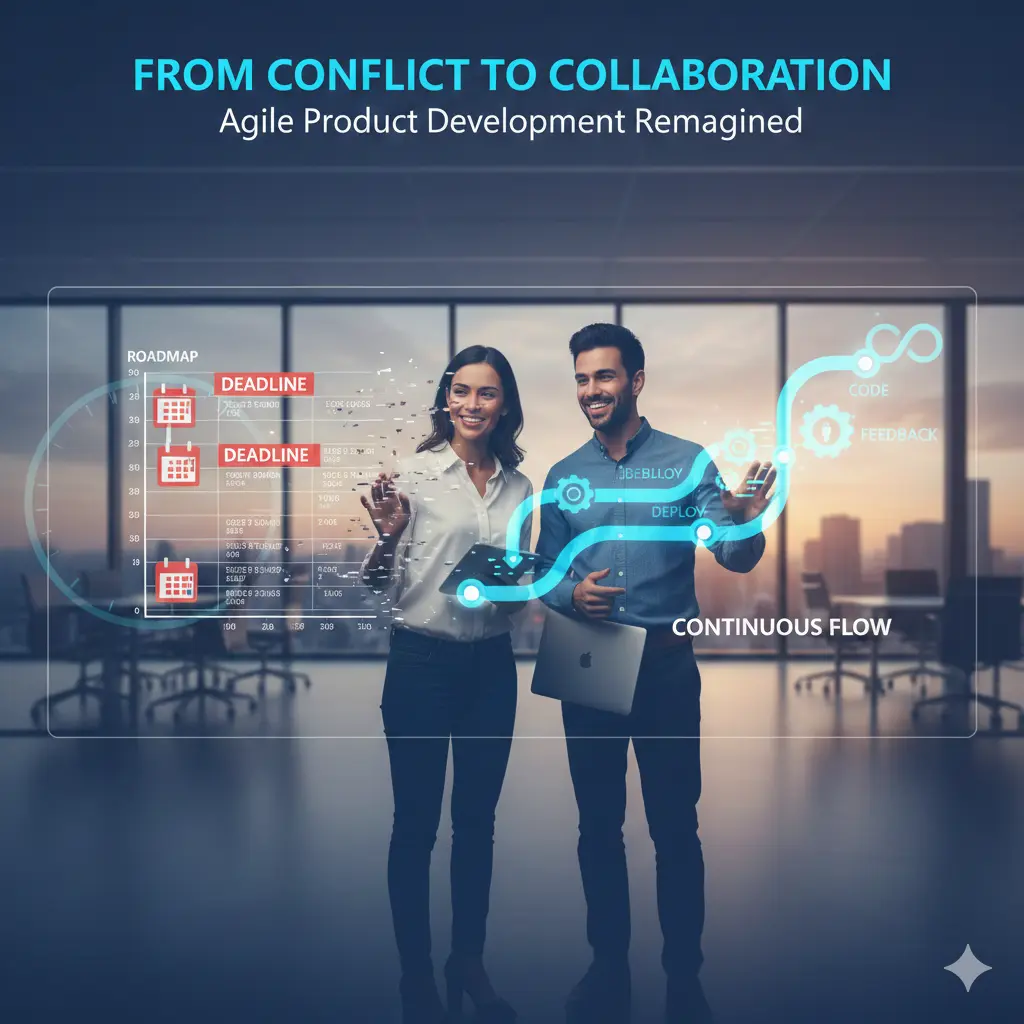
That day, I had my first real conversation about why engineers hate product roadmaps. Not the roadmap itself. But the way we think about releasing software.
For years, I’d been building roadmaps like I was planning a movie production—lock everything in, prepare for opening night, launch with a bang. We’d call it a “release.” We’d coordinate it like a military operation. We’d pray nothing broke.
It always broke.
What I didn’t understand then was this: The roadmap wasn’t the problem. The release model was.
And it took learning about CI/CD pipelines to understand why.
The Roadmap Your Engineers See
Let me tell you what your engineers actually see when you present them with a traditional quarterly roadmap.
They don’t see clarity. They see a lie dressed up in a nice Figma design.
Here’s why:
When you lock a roadmap into “Q1: Feature A, Feature B, Feature C. Q2: Feature D, Feature E, Feature F,” what you’re really saying is:
“These features will launch on these dates, at these times, without any problems, surprises, bugs, or reality interfering with my plan.”
That’s not a roadmap. That’s a fantasy.
But here’s the thing—your engineers know it’s a fantasy the moment they see it.
And knowing you don’t understand this simple truth creates a rift. Because now, every engineer in the room has to translate your fantasy into reality. They have to figure out how to meet your dates despite knowing those dates are arbitrary. They have to work within your constraints while knowing those constraints are imaginary.
It’s like asking someone to run a marathon while their hands are tied. Then blaming them when they don’t finish on time.
The frustration isn’t about hard work. Engineers love hard work. The frustration is about being asked to commit to something that’s fundamentally unknowable.
The Three Lies We Tell About Fixed Roadmaps
Lie #1: We know exactly what we’re building.
We don’t. User feedback changes. Market conditions shift. A competitor launches something unexpected. A bug in your current feature consumes two weeks. A new technology makes your original approach obsolete. Real-world complexity destroys even the best-laid plans within the first month.
Lie #2: We can predict how long it will take.
We can’t. Software estimation is notoriously broken. Studies show that the average software project exceeds its timeline by 40%. That’s not because engineers are bad at math. It’s because software is fundamentally unpredictable—like trying to estimate how long it will take to reach the bottom of a well when you can’t see how deep it is.
Lie #3: Nothing unexpected will happen.
It always does. A database migration takes longer than expected. A third-party API changes without warning. One engineer gets sick. Another finds a security vulnerability that needs immediate patching. Murphy’s Law isn’t a joke in software—it’s a documented pattern.
Your engineers see these three lies the moment you present your roadmap. And they know that in three months, when none of your predictions came true, you’ll blame them for not “delivering on commitments.”
That’s why they hate your roadmap.
The Big Bang Release: Your Greatest Enemy
Now, let me take you deeper into why traditional roadmaps fail so spectacularly.
Most product organizations operate on a “release model” that I call the Big Bang Release.
Here’s how it works:
- Lock the roadmap → Commit to shipping Features A, B, C in Q2.
- Build in isolation → Engineers work for 12 weeks, mostly in branches or staging environments you never see.
- Pray for integration → In the final two weeks, everything gets merged together for the first time. Usually, it breaks catastrophically.
- Panic and patch → The week before launch, you’re firefighting issues nobody anticipated.
- Launch day → Everything goes live at once. Fingers crossed.
- Crisis mode → Your production servers melt. Bugs appear that nobody caught. User experience tanks. Your support team gets 500 angry emails.
I call it the Big Bang Release because it’s all or nothing. You’re not shipping incrementally. You’re shipping everything at once. One version of your product gets replaced with another version of your product, and the entire user base experiences the change simultaneously.
It’s chaos.
And engineers know it’s chaos before it even happens.
Here’s what your engineers are actually thinking during this process:
Week 1-4: “Okay, we’re building this. We can do this.”
Week 5-8: “Wait, the requirements changed. Now we have to refactor. But we’re locked to a date.”
Week 9-11: “Why are we building this? Nobody asked for this anymore. But it’s in the roadmap, so we build it.”
Week 12: “Oh my god, nothing works. This other team’s code broke our code. We have 5 days to fix 47 issues.”
Launch day: “It’s broken. It’s all broken. And the PM is asking why we didn’t ‘catch this in testing.’”
Post-launch: “I’m burnt out. We just spent three months for something that probably could have taken six weeks, and half of it doesn’t work anyway.”
And you know what the PM’s response usually is?
“We need better estimation. Let’s be more careful with our roadmap planning next quarter.”
No. That’s not the problem.
The problem is the release model itself.
Enter CI/CD: The Relationship Repair
Now, let me tell you what changed everything for me.
I was working with a different engineering team, and they started talking about something called CI/CD—Continuous Integration / Continuous Deployment. I nodded along, pretending to understand, but I had no idea what they were actually saying.
So I asked. And they explained it in a way that finally made sense.
Instead of building everything for 12 weeks and launching once, what if you launched every single day?
Not “launched” in the sense of a big release to everyone. But shipped small pieces of work to production continuously, in multiple tiny updates instead of one massive explosion.
My first reaction? “That sounds chaotic and risky.”
My second reaction? “Wait… that’s actually genius.”
Here’s why:
How CI/CD Actually Works (In Plain English)
Continuous Integration means:
Every single day, engineers merge their code changes into the main codebase. Not once every 12 weeks. Every single day. This forces problems to surface immediately instead of hiding until launch day.
Think of it like this: Instead of building a house in secret for a year and revealing it on opening night (hoping everything works), you’re building it with your hands visible the entire time. Everyone can see what’s being built. Issues appear immediately. They get fixed immediately.
Continuous Deployment means:
Once code passes all the automated tests, it automatically gets deployed to production. Not manually, not on a specific launch day. Automatically.
This is wild to product managers. “You mean features go live without my approval?”
Yes. But here’s the beautiful part: Features go live small. They go live incrementally. And if something breaks, you’ve only broken a small thing, not your entire product.
What This Means for Your Roadmap (And Your Relationship with Engineering)
Now here’s where it gets interesting for product managers.
With CI/CD, the roadmap fundamentally changes.
Instead of: “Q2: Ship Features A, B, C”
You’re saying: “Q2: Continuously ship small increments of value. We’ll learn along the way.”
Instead of committing to a date, you’re committing to a direction.
Instead of predicting how long things take, you’re measuring how fast you can deliver value in small pieces.
Your engineers suddenly aren’t trying to commit to something unknowable. They’re saying: “Here’s how much we can ship this week. Let’s ship it. Let’s see what users think. Then let’s decide what to ship next.”
This is a fundamentally different conversation.
And engineers don’t hate this conversation. They love it.
Because now, engineering isn’t a constraint. It’s a collaborator. You’re not forcing them to meet arbitrary dates. You’re asking them: “How can we deliver value faster?”
The Naked Truth About What Your Engineers Really Want
I want to be raw here for a second.
Your engineers don’t hate you. They don’t hate product management. They don’t even hate your roadmap specifically.
What they hate is being set up for failure.
When you lock a roadmap, you’re not giving them clarity. You’re putting them in an impossible position and then blaming them when they can’t deliver the impossible.
It’s not malice. It’s just… a broken system.
Here’s what engineers actually want:
1. Autonomy in how they build
When you say “Ship Feature X by March 15,” you’re not giving them autonomy. You’re giving them a prison sentence with a date.
When you say “We need users to be able to do X. Help me figure out the smallest way to do it this week,” you’re partnering with them.
2. Visibility into why they’re building
Engineers aren’t motivated by deadlines. They’re motivated by impact. Tell them the outcome you want, not the date you want it by. “We need to reduce customer churn by 10%” is more motivating than “Finish the retention feature by Q2.”
3. Permission to iterate
Your roadmap says everything launches perfectly. But software doesn’t work that way. Engineers want permission to ship small, measure, learn, and improve. Not to hit a deadline and move on.
4. Protection from changing requirements
This is huge. When you lock the roadmap, then change it mid-quarter, engineers feel whiplashed. CI/CD actually solves this because you’re not “changing” anything. You’re adjusting the continuous stream. It’s expected. It’s normal. It’s okay.
The Business Case: Why CI/CD Makes You Better at Product Management
Now let me flip this around and show you why this is actually better for your product strategy, not worse.
Most PMs think: “If we don’t lock the roadmap, we’ll lose direction. We’ll ship chaos. We’ll confuse users.”
That’s backwards.
With CI/CD, you’re not losing direction. You’re gaining agility.
Real-Time Feedback Loop
With Big Bang releases, you ship every three months. Then you wait two weeks for data. By the time you know if a feature worked, you’re three weeks into building the next three features. If the data says “this didn’t work,” it’s too late. You’re committed.
With CI/CD, you ship every day. By day three, you know if something is working. By day five, you’ve already optimized it. By day seven, you’re ready to pivot if needed.
That’s seven days of learning versus three months. You’re not moving slower. You’re moving smarter.
Lower Risk
I just realized something while building AgriSuite. When you ship one massive release, you have one massive failure mode. Literally everything can break at once.
With CI/CD, you ship small pieces. If 1% of code breaks, only 1% of functionality is affected. Most users don’t notice. You fix it in two hours. Life goes on.
This isn’t just risk management. It’s customer care. Your customers experience fewer catastrophic outages. Your product is more stable. Your reputation is better.
Faster Time to Value
When you ship incrementally, every feature is in customer hands sooner. That means you’re creating value sooner. That means revenue/retention/engagement starts improving sooner. That means your business metrics start moving sooner.
Instead of waiting three months to see if your big feature helps retention, you’re seeing results in three weeks. That’s massive.
Better Resource Allocation
With a locked roadmap, you’re committed to every feature you wrote down. Even if a feature becomes obviously wrong mid-build, you finish it because it’s on the roadmap.
With CI/CD, you’re constantly making decisions: “Is this still the right thing to build? Should we pivot? Should we double-down?”
That means you’re not wasting resources on features that don’t matter. You’re being ruthlessly efficient.
How to Make the Transition (Without Losing Your Mind)
Okay, so you’re convinced. CI/CD is better. But how do you actually change your organization to work this way?
I’m not going to tell you it’s easy. It’s not. But it’s worth it.
Step 1: Start Smaller Than You Think
Don’t try to change your entire release process overnight. Start with one team. One feature. One sprint cycle.
Give them permission to ship incrementally. Set a direction (“Improve checkout flow”), but don’t set a date. Let them ship the first improvement. Measure it. Learn from it. Ship the next improvement.
You’ll be shocked at how fast you iterate this way. And your engineers will suddenly stop resenting you.
Step 2: Release the Grip on Dates
This is hard for PMs because executives love dates. It feels safe to commit to a date.
But here’s the thing: You’re not actually safer. You’re just lying earlier.
Instead, commit to this: “We’re shipping continuously. You’ll see value in two weeks. We’ll hit our metrics in six weeks.”
That’s more truthful than “Everything launches on March 15.”
Step 3: Focus on Outcomes, Not Outputs
Stop saying “Ship the AI features.” Start saying “Reduce time to generate insights by 50%.”
Your engineers will figure out how to do it. Maybe they do it through AI. Maybe they do it through better UI. Maybe they do it through caching. Who cares? The outcome is what matters.
When you focus on outcomes, engineers have autonomy. And autonomous engineers are happy engineers.
Step 4: Invest in Automation
CI/CD requires automation. You need automated tests. You need deployment pipelines. You need monitoring.
This takes investment upfront. But it pays dividends forever.
Why? Because every deployment is now safe. Every deployment is now testable. Every deployment is now reversible. This means engineers aren’t scared to deploy. They’re excited about it.
The Real Relationship Change
Here’s what actually changed when I learned about CI/CD and started advocating for it.
The relationship between product and engineering stopped being adversarial.
When you’re in a Big Bang release model, product and engineering are naturally opposed:
- Product wants to pack in features and lock dates.
- Engineering wants to reduce scope and extend dates.
- They meet in the middle, both unhappy, both compromised.
But with CI/CD, you’re aligned.
- Product wants to ship value continuously.
- Engineering wants to ship value continuously.
- You’re working toward the same goal.
Marcus (the engineer who called out my bullshit roadmap) eventually became one of my closest collaborators. We started having conversations like:
“What’s the smallest thing we can ship this week that moves the needle?”
Instead of:
“Why isn’t this feature done by the deadline?”
One conversation is about partnership. The other is about blame.
The shift from one to the other literally changed my career as a product manager. And it changed the product we built—it was better, faster, and more aligned with what users actually needed.
The Drip-Feed Strategy: Your New Roadmap
So what does a CI/CD-aligned roadmap actually look like?
I call it the Drip-Feed Strategy.
Instead of: “Q2: Feature A, Feature B, Feature C”
You say: “Q2: Continuous improvement to [outcome]. Weekly releases. Incremental value.”
And then you break the big outcome into small pieces:
- Week 1: Build foundation. Ship basic version to 5% of users.
- Week 2: Get feedback. Iterate. Ship to 25% of users.
- Week 3: Measure impact. Optimize. Ship to 50% of users.
- Week 4: Scale based on learning. Ship to 100% of users.
- Weeks 5-8: Continue optimizing based on real-world data.
Every step is a release. Every release is small. Every release teaches you something.
And here’s the beautiful part: You’re not “delaying” anything. You’re accelerating learning.
The Hard Conversations (Because They’re Real)
Now, I want to be honest about the challenges.
Your executives will freak out.
“So you’re telling me we don’t have a roadmap? We don’t know when features launch?”
Yes, you do. You know the outcomes. You know the direction. You know the cadence (weekly releases). What you don’t know is the exact date that Feature X ships in its final form.
And honestly? That’s fine. Features aren’t finished products. They’re starting points. They launch, users interact with them, you learn, you iterate.
Your sales team will also freak out.
“Wait, so I can’t tell customers when the feature they’re asking for will ship?”
You can tell them the direction: “We’re working on it. You’ll see an initial version in two weeks. We’ll improve it every week based on feedback.”
That’s actually more honest than “It ships on March 15” (which you know will probably slip).
You’ll feel like you’re losing control.
You are. But you were never in control. You were just lying to yourself about being in control.
When you embrace CI/CD, you’re acknowledging reality: You can’t predict the future perfectly. But you can respond to it faster than anyone else.
That’s not losing control. That’s gaining wisdom.
The Day Everything Changed Again
Fast-forward two years.
I was now at a company that had fully embraced CI/CD. We shipped new features or improvements almost every day. Our roadmap was a simple one-page document with outcomes and directions, not dates and deliverables.
My engineering team had grown from 8 to 25 people. But instead of friction, we had momentum.
In a quarterly planning meeting, an engineer raised their hand. Not to object. To suggest.
“What if instead of focusing on X this quarter, we focused on reducing technical debt? It’ll make shipping Y and Z way faster.”
The old me would have said “No, it’s not on the roadmap.”
The new me said “Show me the impact. If it helps us move faster, let’s do it.”
And we did. We took two weeks to pay down debt. And then the next six weeks of shipping were twice as fast.
That engineer wasn’t resisting the roadmap. They were contributing to it.
Because the roadmap wasn’t locked. It was alive. It was flexible. It was collaborative.
That’s when I realized: The roadmap isn’t the enemy. The release model is. And when you change the release model, everything else changes too.
Your Roadmap Doesn’t Have to Be the Enemy
Let me leave you with this:
Your engineers don’t hate your roadmap because it’s ambitious. They hate it because it’s pretending to be certain about something that’s fundamentally uncertain.
The fix isn’t to remove the roadmap. It’s to change what the roadmap actually means.
Instead of a series of definitive promises, make it a series of directions and outcomes. Instead of launch dates, commit to cadence and learning. Instead of locking requirements, lock outcomes and iterate.
This is CI/CD thinking applied to product management.
And here’s the thing: It actually makes you better at your job.
You’ll move faster. You’ll learn quicker. You’ll adapt better. You’ll disappoint fewer people. You’ll build products that users actually love instead of products that match your original prediction.
Your engineers will stop resenting you.
And you might even stop resenting yourself for making promises you can’t keep.
The Final Truth
I used to think the problem was my engineers weren’t good at estimation.
Then I learned: The problem wasn’t estimation. The problem was that I was asking for something that can’t be estimated accurately.
Software development isn’t like construction. You can’t predict how long it takes to drill a hole. You can predict the distribution of time across many holes.
But you can’t predict one specific hole.
And when you try to predict one specific feature at one specific date, you’re predicting the unpredictable.
CI/CD doesn’t make the unpredictable predictable. It makes you comfortable with unpredictability.
And that comfort—that acceptance of reality—is where great product management actually starts.
Your engineers aren’t resistant to change. They’re resistant to false certainty.
Give them real processes instead. Give them small increments. Give them learning loops. Give them partnership.
And watch your relationship transform.
🚀 Ready to Transform Your Release Strategy?
If you resonated with this post, you’re probably ready to have a real conversation with your engineering team about how you release products.
Here’s what to do next:
Share this with your engineering lead. See what they think. Their reaction will be enlightening.
Start small. Pick one feature. One team. One sprint. Try the drip-feed approach. Measure the results.
Track what changes. Time to first release. Customer feedback cycles. Team morale. Number of post-launch bugs. You’ll be surprised at how much improves.
Iterate on your process. CI/CD isn’t a destination. It’s a journey. You’ll learn what works for your team. Embrace that learning.
The roadmap doesn’t have to be the thing that destroys your relationship with engineering.
It can be the thing that builds it.
The choice is yours.
Let’s Connect & Keep Learning
If these insights about product management, DevOps, and engineering collaboration resonated with you, I’d love to hear your story.
Are you struggling with roadmap alignment? Have you successfully transitioned to CI/CD? What’s your biggest friction point between product and engineering?
Join me on LinkedIn — I share weekly insights on product strategy, DevOps for non-technical PMs, and the honest truths about building software that works and building teams that trust each other.
Let’s build better products. Together.
Share this post if it helps even one PM understand why their engineers are frustrated. Your engineering team will thank you.
#ProductManagement #DevOps #EngineeringCollaboration #CICD #ProductStrategy #Roadmaps #AgileDelivery #LeadTime #ProductRoadmap #ReleaseManagement #ContinuousDelivery #AgileProductManagement