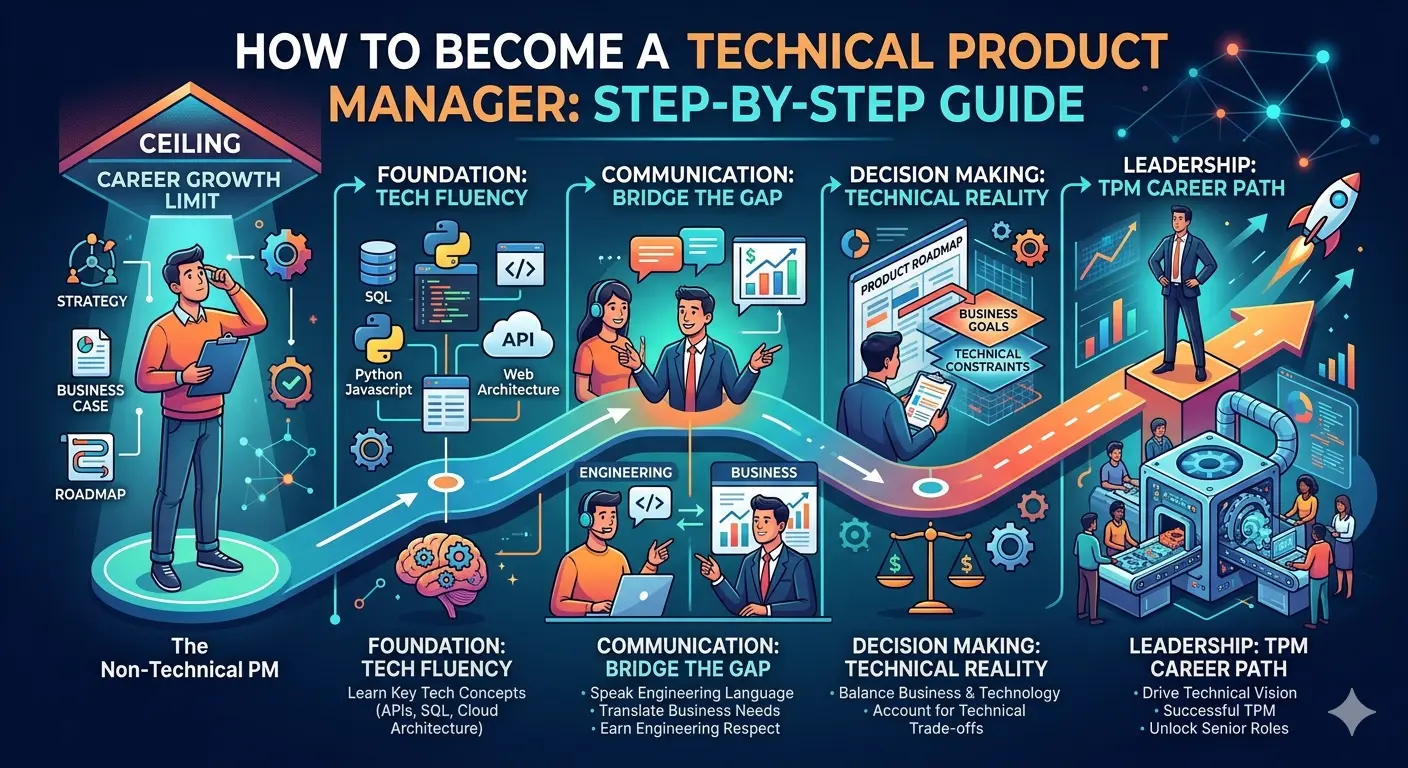
📚 Table of Contents
- The Technical PM Career Path
- Technical PM vs Regular PM: Key Differences
- Prerequisites and Background Requirements
- Technical Skills Assessment: Where Do You Stand?
- Learning Path: 90-Day Technical Upskilling Plan
- Building Your Technical Portfolio
- Interview Preparation for Technical PM Roles
- Companies Hiring Technical PMs
- Salary Expectations and Career Growth
- Action Plan: Your First 30 Days
The Technical PM Career Path
Two years ago, a PM friend of mine hit a ceiling. She’d been a successful product manager for five years, owned a $20M product line, and consistently hit her KPIs. But every senior role she interviewed for went to someone else.
The feedback was always some version of: “You’re great at product strategy, but we need someone who can go deeper with engineering.”
The naked truth: In 2026, the most valuable product managers are the ones who bridge business and technology. Not just translate between them—actually understand both at a meaningful depth.
This isn’t about becoming a developer. It’s about becoming fluent in the language your engineering team speaks. It’s about earning their respect. It’s about making decisions that account for technical reality, not just business wishes.
A technical product manager isn’t a developer who does product. They’re a product manager who can hold their own in technical conversations.
The good news? You don’t need a computer science degree. You don’t need to have been a developer. What you need is a structured approach to building technical depth.
I’ve helped dozens of PMs make this transition. Some came from design backgrounds. Some from marketing. Some from finance. All of them made it with the right strategy and consistent effort.
This guide is that strategy.
Technical PM vs Regular PM: Key Differences
Before we dive into how to become a technical PM, let’s be clear about what you’re becoming.
The Core Distinction
| Aspect | Regular PM | Technical PM |
|---|---|---|
| Focus | User needs, business metrics | System architecture, technical feasibility |
| Engineering conversations | “What can we build?” | “How should we build this?” |
| Documentation | PRDs, user stories | PRDs + technical specs, architecture reviews |
| Decision-making | Business impact priority | Business impact + technical debt balance |
| Team trust | Earned through delivery | Earned through delivery + technical competence |
What Changes Day-to-Day
Regular PM Typical Day:
9:00 AM - Stakeholder meeting about Q3 roadmap
10:30 AM - Review user research findings
11:00 AM - Write PRD for new feature
1:00 PM - Design review with UX team
2:00 PM - Prioritization session with stakeholders
3:00 PM - Customer interview
4:00 PM - Sync with engineering lead
Technical PM Typical Day:
9:00 AM - Architecture review for new service design
10:30 AM - Technical spec writing for API changes
11:00 AM - Deep dive on system performance metrics
1:00 PM - Design review (including technical feasibility)
2:00 PM - Trade-off discussion: build vs buy decision
3:00 PM - Customer interview (with technical context)
4:00 PM - Sprint planning with engineering team
The difference isn’t dramatic on the surface. But dig deeper and you’ll see the technical PM is:
- Participating in architecture discussions, not just receiving decisions
- Writing technical specifications that engineers respect
- Making decisions with technical context, not just business context
- Balancing short-term delivery with long-term system health
The Respect Factor
Here’s something uncomfortable to admit: many engineers don’t respect product managers.
Not because PMs aren’t smart. Not because they don’t work hard. But because engineers have sat through too many meetings where the PM proposed something impossible, prioritized something inefficient, or made promises without understanding technical implications.
Technical competence earns you a seat at the table where real decisions get made. Without it, you’re a passenger, not a driver.
A technical PM who can:
- Review a system diagram and spot bottlenecks
- Understand the implications of technical debt
- Make prioritization decisions that account for engineering reality
- Write specs that engineers don’t have to rewrite
This PM gets taken seriously. Their opinions matter. Their career accelerates.
Common Misconceptions
“Technical PMs code all day.” No. Technical PMs understand code enough to be dangerous. They might write scripts occasionally. But their job is still product management, not development.
“You need a CS degree to be a technical PM.” No. Some of the best technical PMs I know studied philosophy, psychology, or economics. The degree doesn’t matter. The knowledge does.
“Technical PMs are just failed engineers.” No. Technical PMs choose product because they love the intersection of technology and business. Many could be engineers; they prefer product.
“Technical PMs don’t need soft skills.” No. Technical PMs need better soft skills because they operate at the intersection of multiple disciplines. Technical depth without communication skills is just being a bad engineer.
Prerequisites and Background Requirements
Let’s be honest about what you need before starting this journey.
Essential Foundations
1. Core Product Management Skills
You should already be competent at:
- Writing clear PRDs and user stories
- Prioritization frameworks (RICE, MoSCoW, etc.)
- Stakeholder management
- User research and discovery
- Data analysis and metrics
- Roadmap planning
If you’re still learning these, master them first. Technical depth on top of weak product fundamentals doesn’t make you a technical PM—it makes you a confused engineer.
2. Basic Technical Literacy
You should already understand:
- What an API is and why it matters
- The difference between frontend and backend
- What a database does at a high level
- How the internet works (broadly)
- What “the cloud” means in practical terms
If you don’t have this, start here. These are table stakes for any modern product manager, technical or not.
Background Routes
Different starting points require different journeys:
From Non-Technical Background (Marketing, Design, Business):
Starting point: Good product instincts, limited technical knowledge
Timeline to TPM: 6-12 months of focused learning
Advantage: Strong user empathy, communication skills
Challenge: Building technical credibility from scratch
From Semi-Technical Background (Analytics, Operations, Support):
Starting point: Some technical exposure, good with data
Timeline to TPM: 3-6 months of targeted learning
Advantage: Already comfortable with some technical concepts
Challenge: Deepening from surface-level to meaningful understanding
From Engineering Background:
Starting point: Strong technical foundation, limited product skills
Timeline to TPM: 3-6 months of product skill development
Advantage: Instant credibility with engineering teams
Challenge: Learning to think like a PM, not an engineer
The Realistic Timeline
Most PMs can transition to technical PM in 6-12 months of consistent effort. Not casual interest—consistent, structured effort. 5-10 hours per week dedicated to technical learning.
That might seem like a lot. But consider: this is a career investment that will pay dividends for the next 20-30 years.
Technical Skills Assessment: Where Do You Stand?
Before building a learning plan, assess your current state honestly.
Self-Assessment Framework
Rate yourself 1-5 on each dimension:
1 = I don’t understand this at all 2 = I’ve heard of this but couldn’t explain it 3 = I understand the concept but haven’t applied it 4 = I can apply this in practical situations 5 = I could teach this to others
Systems & Architecture
| Skill | Self-Rating (1-5) | Notes |
|---|---|---|
| Understanding of client-server architecture | ||
| Microservices vs monolith trade-offs | ||
| System scalability concepts | ||
| Database types (SQL vs NoSQL) and use cases | ||
| Caching strategies | ||
| Load balancing and high availability | ||
| API design principles (REST, GraphQL) | ||
| Subtotal |
Development Practices
| Skill | Self-Rating (1-5) | Notes |
|---|---|---|
| Version control (Git) concepts | ||
| CI/CD pipeline understanding | ||
| Testing types (unit, integration, E2E) | ||
| Code review process and value | ||
| Technical debt concept and management | ||
| Development estimation accuracy | ||
| Agile/Scrum technical aspects | ||
| Subtotal |
Infrastructure & Operations
| Skill | Self-Rating (1-5) | Notes |
|---|---|---|
| Cloud computing basics (AWS/GCP/Azure) | ||
| Containerization concepts (Docker) | ||
| Orchestration basics (Kubernetes) | ||
| Infrastructure as Code concepts | ||
| Monitoring and observability | ||
| Security fundamentals | ||
| Performance optimization | ||
| Subtotal |
Data & Analytics
| Skill | Self-Rating (1-5) | Notes |
|---|---|---|
| SQL basics (can write queries) | ||
| Data modeling concepts | ||
| Analytics implementation (event tracking) | ||
| A/B testing technical aspects | ||
| Data pipeline basics | ||
| Business intelligence tools | ||
| Machine learning fundamentals | ||
| Subtotal |
Interpreting Your Score
Total Score 80-140: You’re already a technical PM. Focus on advanced topics and leadership.
Total Score 50-79: You have solid foundations. A focused 3-6 month plan will get you to TPM level.
Total Score 25-49: You’re in the learning phase. Plan for 6-12 months of structured learning.
Total Score Below 25: Start with fundamentals. Don’t rush. Build a strong foundation first.
The Gap Analysis
For each skill where you rated yourself below 4, ask:
- Is this relevant to my current role? (Some skills matter more than others depending on your product)
- What would it take to get to level 4? (Course, project, mentorship?)
- What’s the priority? (Focus on high-impact, high-relevance gaps first)
Learning Path: 90-Day Technical Upskilling Plan
Here’s a structured plan to take you from where you are to technical PM competence. Adjust timelines based on your starting point.
Phase 1: Foundations (Days 1-30)
Week 1-2: Systems Thinking
Start with how systems work, not specific technologies.
Resources:
- Book: “Designing Data-Intensive Applications” by Martin Kleppmann (read Part 1)
- Course: “Cloud Computing Basics” on Coursera (free audit)
Practical Application:
Draw a system diagram of your current product:
- What are the main components?
- How do they communicate?
- Where are the data stores?
- What are the potential bottlenecks?

Review with an engineer on your team. Ask for feedback.
Week 3-4: Development Lifecycle
Understand how code becomes product.
Resources:
- Book: “The Phoenix Project” (gives context on DevOps)
- Course: “Git & GitHub Crash Course” on freeCodeCamp (free)
Practical Application:
# Set up a simple Git workflow
1. Create a GitHub account if you don't have one
2. Fork a repository
3. Make a change, commit it, create a PR
4. Merge your PR

Yes, this is basic. Do it anyway. The familiarity matters.
End of Phase 1 Checkpoint:
- Can explain client-server architecture to a non-technical person
- Understand what happens when you “deploy” code
- Can describe the software development lifecycle
- Have a basic Git workflow set up
Phase 2: Technical Depth (Days 31-60)
Week 5-6: APIs and Data
Resources:
- Course: “APIs for Beginners” on freeCodeCamp (free)
- Book: Continue “Designing Data-Intensive Applications” (Part 2)
Practical Application:
// Make an API call and understand what's happening
// Use Postman or curl to:
// 1. Call a public API (like weather or joke API)
// 2. Examine the request and response
// 3. Understand headers, status codes, body

// Then write a simple API documentation for a fictional feature:
// - What endpoints exist?
// - What data do they accept/return?
// - What error cases exist?
Week 7-8: Infrastructure and Cloud
Resources:
- Course: “AWS Fundamentals” on Coursera (free audit) or similar for GCP/Azure
- Article: “Kubernetes for Product Managers” (various free resources online)
Practical Application:
Create a simple cloud architecture diagram:
1. What services does your product use?
2. What would a basic cloud setup look like?
3. Where is data stored? Where is compute done?

Present to an engineer for feedback.
End of Phase 2 Checkpoint:
- Can read and understand basic API documentation
- Can explain REST principles
- Understand database basics (tables, relationships, queries)
- Can discuss cloud infrastructure at a conceptual level
Phase 3: Practical Application (Days 61-90)
Week 9-10: Hands-On Project
This is where you prove to yourself (and future employers) that you can apply what you’ve learned.
Project: Build a Simple Backend for a Product Concept
# Option 1: Python with Flask (beginner-friendly)
from flask import Flask, jsonify, request

app = Flask(__name__)

# In-memory database (keep it simple)
products = [
    {"id": 1, "name": "Widget A", "price": 9.99},
    {"id": 2, "name": "Widget B", "price": 19.99}
]

@app.route('/products', methods=['GET'])
def get_products():
    return jsonify(products)

@app.route('/products/<int:product_id>', methods=['GET'])
def get_product(product_id):
    product = next((p for p in products if p['id'] == product_id), None)
    if product:
        return jsonify(product)
    return jsonify({"error": "Product not found"}), 404

@app.route('/products', methods=['POST'])
def create_product():
    new_product = {
        "id": len(products) + 1,
        "name": request.json['name'],
        "price": request.json['price']
    }
    products.append(new_product)
    return jsonify(new_product), 201

if __name__ == '__main__':
    app.run(debug=True)
Deliverables:
- Working API with at least 3 endpoints
- README explaining how to run it
- Simple documentation of the API
Week 11-12: Integration with Current Role
Apply what you’ve learned to your current job.
For your next feature:
1. Write the PRD as usual
2. Add a "Technical Considerations" section including:
   - System components affected
   - Data model changes required
   - API changes needed
   - Performance implications
   - Security considerations

3. Present this to engineering before any implementation begins
4. Iterate based on their feedback
This is the moment you transition from learning to doing. The technical considerations section in your PRD proves you’re thinking like a technical PM.
End of Phase 3 Checkpoint:
- Have a working code project in your GitHub
- Can add technical depth to product documents
- Can participate meaningfully in technical discussions
- Engineers have noticed the change in your contributions
Optional: Deep Dive Tracks
After the 90 days, choose a specialization based on your product area:
Platform PM Track:
- Deep dive into microservices
- Study platform-as-a-product concepts
- Learn service mesh and API gateway patterns
Data/AI PM Track:
- Advanced SQL and data modeling
- Machine learning fundamentals
- Data pipeline architecture
Infrastructure PM Track:
- Kubernetes deep dive
- Infrastructure as Code (Terraform)
- Site Reliability Engineering concepts
Building Your Technical Portfolio
A portfolio proves your skills. It’s not just for job applications—it’s a living record of your technical growth.
Portfolio Components
1. GitHub Presence
Your GitHub profile should show:
- Active contributions (even small ones)
- At least 2-3 projects you've built
- Clear README files
- Code that someone else could understand and run
2. Technical Writing
Publish content that demonstrates technical understanding:
- System design analyses of popular products
- Technical retrospectives on features you’ve shipped
- Explainers of technical concepts for non-technical audiences
Writing about technical topics forces you to understand them deeply. The act of teaching solidifies learning.
3. Architecture Diagrams
Create clear, thoughtful diagrams:
What makes a good architecture diagram:
- Shows system boundaries clearly
- Indicates data flow with arrows
- Labels all components
- Notes key technologies
- Highlights critical paths and bottlenecks
4. Real Work Samples
With permission from your employer:
- Redacted technical specs you’ve written
- Architecture decision records you’ve contributed to
- Sprint retrospectives with technical focus
Portfolio Structure
your-portfolio/
├── README.md                 # Professional introduction
├── projects/
│   ├── api-project/          # Your backend project
│   │   ├── code/
│   │   ├── README.md
│   │   └── api-docs.md
│   └── data-project/         # Data analysis or SQL project
├── writing/
│   ├── system-design-analyses/
│   ├── technical-explainers/
│   └── retrospectives/
└── diagrams/
    ├── system-architecture/
    └── data-flow/
What Hiring Managers Look For
When I hire technical PMs, I look for:
| Signal | What It Shows |
|---|---|
| Consistent GitHub activity | You actually code, not just talk about it |
| Clear technical writing | You can communicate complex ideas simply |
| Thoughtful system diagrams | You think architecturally |
| Real project documentation | You understand the PM-engineering interface |
Interview Preparation for Technical PM Roles
Technical PM interviews are different from regular PM interviews. Here’s how to prepare.
Interview Structure
Most technical PM interviews include:
- Product Sense (standard PM questions)
- Technical Depth (specific to TPM)
- System Design (lighter version of engineering interviews)
- Behavioral (leadership, influence, collaboration)
Technical Interview Question Types
Type 1: API Design Questions
Example: “Design an API for a ride-sharing service.”
How to approach:
1. Clarify requirements (what entities, what operations)
2. Define resources (users, rides, drivers, payments)
3. Design endpoints with HTTP methods
4. Consider error handling and edge cases
5. Discuss authentication and security

Example answer structure:
- Users: GET /users/{id}, POST /users, PUT /users/{id}
- Rides: GET /rides, POST /rides, POST /rides/{id}/complete
- Drivers: GET /drivers/nearby, PUT /drivers/{id}/availability
- Payments: POST /payments, GET /payments/{id}
Type 2: System Design Questions
Example: “Design a URL shortening service like bit.ly.”
How to approach:
1. Clarify scale and requirements
2. Design the data model
3. Sketch the API
4. Think through scalability
5. Address edge cases

Key considerations:
- Read-heavy or write-heavy?
- How to handle collisions?
- How to scale for billions of URLs?
- How to handle analytics?
Type 3: Technical Trade-off Questions
Example: “When would you recommend a monolith vs microservices?”
Monolith advantages:
- Simpler deployment and development
- Easier debugging
- Lower operational complexity
- Faster for small teams

Microservices advantages:
- Independent scaling
- Team autonomy
- Technology flexibility
- Fault isolation

The right answer: "It depends" with specific considerations for:
- Team size and structure
- Scale requirements
- Domain complexity
- Organizational maturity
Type 4: Data Questions
Example: “How would you design an A/B testing system?”
-- You should be able to discuss:
-- 1. How to assign users to variants (hashing)
-- 2. How to track events
-- 3. How to analyze results

-- Basic query to analyze experiment:
SELECT
  variant,
  COUNT(DISTINCT user_id) as users,
  SUM(CASE WHEN event = 'conversion' THEN 1 ELSE 0 END) as conversions,
  SUM(CASE WHEN event = 'conversion' THEN 1 ELSE 0 END) * 1.0 /
    COUNT(DISTINCT user_id) as conversion_rate
FROM experiment_events
WHERE experiment_id = 'checkout_redesign_v2'
GROUP BY variant;
Preparation Strategy
Week 1: System Design Fundamentals
- Study “Designing Data-Intensive Applications” (finish the book)
- Practice drawing system diagrams
- Watch “System Design Interview” videos on YouTube
Week 2: Practice Questions
- Do 2-3 mock interviews with friends or mentors
- Record yourself answering technical questions
- Review and improve your explanations
Week 3: Product + Technical Integration
- Practice connecting product decisions to technical implications
- Prepare stories that demonstrate technical judgment
- Refine your portfolio presentation
Common Mistakes to Avoid
| Mistake | Fix |
|---|---|
| Trying to sound more technical than you are | Be honest about your level, show how you’d learn |
| Ignoring business context in technical answers | Always tie technical decisions to business outcomes |
| Over-engineering solutions | Start simple, then discuss scaling |
| Not asking clarifying questions | Always clarify requirements before diving in |
Companies Hiring Technical PMs
The demand for technical PMs is strong across industries. Here’s where to look.
Big Tech
| Company | Typical TPM Focus | What They Value |
|---|---|---|
| Platforms, infrastructure, AI | Strong technical depth, system design | |
| Amazon | AWS, consumer products, devices | Customer obsession, scalability thinking |
| Microsoft | Azure, Office, AI | Platform thinking, enterprise experience |
| Meta | Platforms, infrastructure, VR/AR | Scale, innovation, fast iteration |
| Apple | Services, devices, platforms | User experience, hardware-software integration |
High-Growth Startups
Look for companies where:
- Engineering team is 20+ people
- Product has technical complexity (infrastructure, APIs, data)
- Company is scaling and needs process
Where to find them:
- AngelList/Wellfound
- Y Combinator jobs board
- Company career pages directly
- LinkedIn (set alerts for “Technical Product Manager”)
Specialized Roles
| Role Type | Description | Key Skills |
|---|---|---|
| Platform PM | Build internal platforms for engineers | Developer experience, APIs, infrastructure |
| Data PM | Products centered on data/analytics | SQL, data pipelines, ML basics |
| Infrastructure PM | Cloud and infrastructure products | Cloud platforms, DevOps, reliability |
| API PM | Developer-facing APIs and SDKs | API design, developer experience, documentation |
Salary Expectations and Career Growth
Let’s talk money. Technical PMs command a premium.
Salary Comparison (US Market, 2024-2026)
| Level | Regular PM | Technical PM | Premium |
|---|---|---|---|
| Junior (1-3 years) | $90-130K | $100-145K | +10-15% |
| Mid (3-5 years) | $130-180K | $150-210K | +15-20% |
| Senior (5-8 years) | $180-250K | $210-300K | +15-20% |
| Staff/Principal (8+ years) | $250-350K | $300-450K | +15-30% |
Equity adds significantly to these numbers at tech companies.
Career Progression
Technical PM Career Ladder:

Technical PM (L4-L5)
├── Own features with technical complexity
├── Write technical specs
└── Influence engineering decisions
    │
Senior Technical PM (L5-L6)
├── Own product areas with significant technical scope
├── Drive architecture decisions
└── Mentor other PMs on technical topics
    │
Staff Technical PM (L6-L7)
├── Own cross-cutting technical initiatives
├── Shape technical product strategy
└── Influence org-level decisions
    │
Principal Technical PM (L7+)
├── Define technical product vision
├── Influence company strategy
└── Industry thought leadership
The Long-Term Value
Technical depth compounds. Every year, you build on previous knowledge. Your ability to bridge business and technology becomes your superpower.
Non-technical PMs often hit a ceiling. Technical PMs can grow into:
- VP of Product (for technical products)
- Head of Platform
- CTO (for smaller companies)
- Founder (with technical credibility)
Action Plan: Your First 30 Days
You’ve read the guide. Now it’s time to act. Here’s your 30-day kickoff plan:
Days 1-7: Assessment and Foundation
Day 1-2: Complete the technical skills self-assessment in this guide. Be brutally honest.
Day 3-4: Set up your learning environment:
- Create a GitHub account if you don’t have one
- Install a code editor (VS Code is free and excellent)
- Create a learning journal to track progress
Day 5-6: Order “Designing Data-Intensive Applications” and start reading.
Day 7: Schedule a conversation with a technical mentor or an engineer you respect. Share your assessment and learning plan. Get their input.
Days 8-21: Core Learning
Week 2: Focus on systems thinking and architecture
- Read Part 1 of “Designing Data-Intensive Applications”
- Draw system diagrams for your current product
- Review with an engineer
Week 3: Focus on development lifecycle
- Complete a basic Git/GitHub course
- Set up a simple repository
- Make your first commits and PRs
Days 22-30: Application and Momentum
Week 4: Start integrating technical thinking into your current role
- Add a “Technical Considerations” section to your next PRD
- Participate more actively in technical discussions
- Begin documenting your learning publicly (blog, LinkedIn, etc.)
The Commitment
Write this down. Sign it. Put it somewhere visible:
I commit to spending at least 5 hours per week on technical learning for the next 90 days.
I will:
- Complete one technical course or book every 30 days
- Build at least one coding project in the next 90 days
- Add technical depth to every product document I write
- Seek feedback from engineers on my technical growth
Signed: _________________ Date: _________________
The Bottom Line
Becoming a technical product manager isn’t about becoming a developer. It’s about developing enough technical fluency to:
- Earn respect from engineering teams
- Make better decisions that account for technical reality
- Accelerate your career by accessing higher-value roles
- Build better products by understanding the technology stack
The path is clear. The resources are available. The demand is strong.
The only question is: when do you start?
The best time to start learning technical skills was two years ago. The second best time is today.
Ready to start your technical PM journey? Share your commitment on LinkedIn and tag me—I’d love to cheer you on.
Related Reading:
- Docker and Kubernetes Explained for Product Managers
- Jenkins vs GitHub Actions: A Product Manager’s Comparison
- API Design: A Product Manager’s Guide
About the Author
Karthick Sivaraj is the founder of The Naked PM, a blog focused on DevOps for Product Managers. After transitioning from a traditional PM role to technical product management, he created this resource to help others navigate the same path. He believes technical depth is the multiplier that takes product managers from good to irreplaceable.
Questions about your TPM transition? Drop a comment below or reach out on Twitter/X.
💬 Join the Conversation