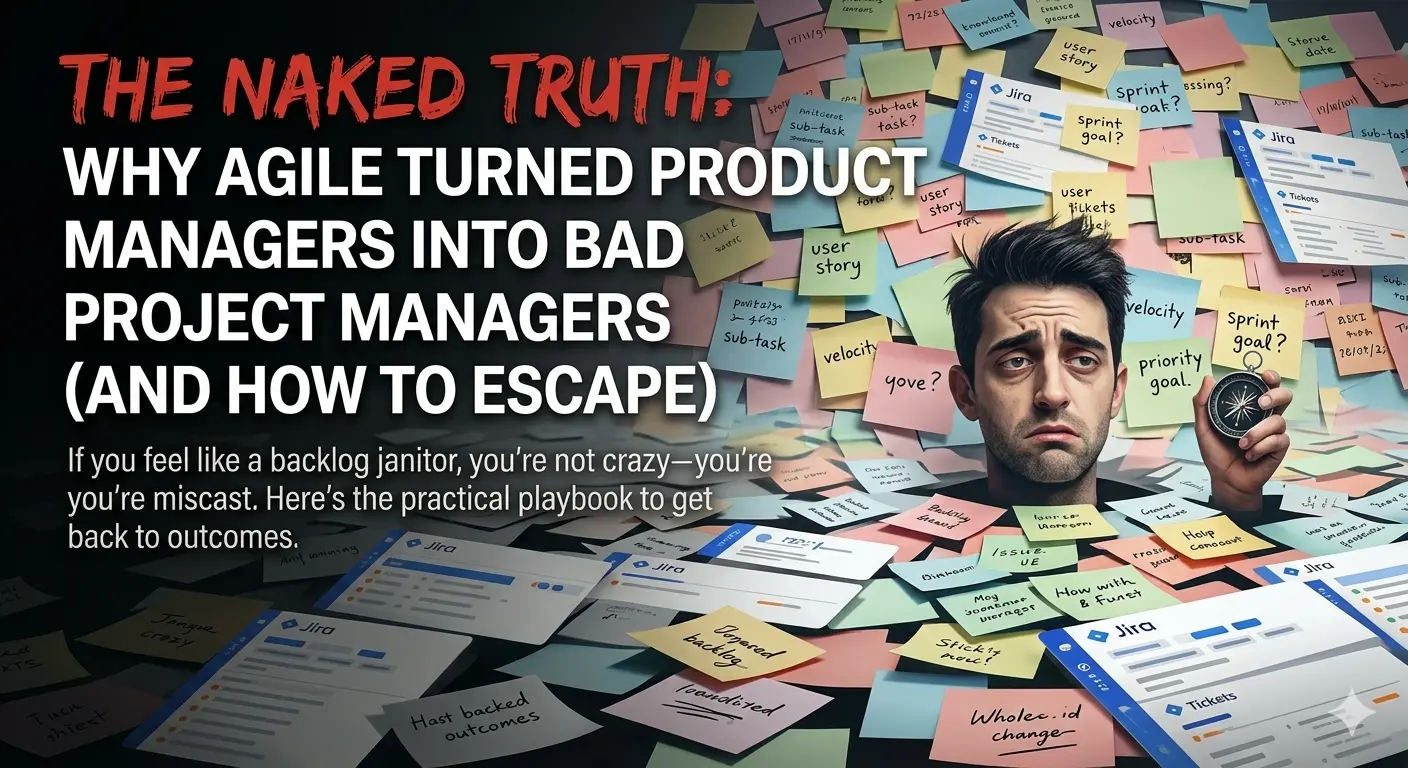
It’s Thursday. 6:12 PM. You’re still online. Not because you’re “passionate.”
Because you’re about to walk into a sprint planning meeting where you’ll be judged like this:
- Not on whether customers got happier.
- Not on whether revenue moved.
- Not on whether churn dropped.
But on whether your tickets are “ready.”
If your PM job feels like being a project manager with extra anxiety… that’s not a personal failure. That’s the system.
And yes — this happens everywhere.
📚 Table of Contents
- The Friday Night Pattern (That Keeps Repeating)
- The Naked Truth (What’s Actually Happening)
- The Real Impact (On Product, Team, and You)
- The Escape Plan: From Ticket Boss to Outcome Owner
- Future-Proofing: How to Avoid This Next Time
The Friday Night Pattern (That Keeps Repeating)
Let me guess your week.
Monday: You pitch outcomes. Everyone nods. “Love the strategy.”
Tuesday: A stakeholder “just needs” a small change. It’s urgent. Always urgent.
Wednesday: Refinement. You bring a clean problem statement. The room wants a perfectly sliced set of tasks.
Thursday: Engineers ask for “more clarity.” You write more tickets. You call it alignment. You feel productive. You’re not.
Friday: Someone says: “We missed sprint goal.”
And quietly—nobody says it out loud—you realize:
The sprint goal was never a customer goal. It was a calendar goal.
That’s how agile turns PMs into bad project managers: you spend your attention optimizing the machine instead of the product.
The Naked Truth (What’s Actually Happening)
Here’s the truth nobody writes on the transformation slide deck.
1) Your company confused PM with PO… then gave you the PO chores
Some orgs treat “Product Owner” as “person who writes the backlog.” So the most expensive brain in the room becomes the cheapest labor.
Symptoms:
- You’re praised for “well-written stories” more than good decisions.
- “Definition of Ready” matters more than “definition of success.”
- You’re the translator between stakeholder chaos and engineering reality.
Naked truth: You are being graded on documentation quality, not product leadership.
2) Agile became a safety blanket for leaders who hate uncertainty
Outcomes are uncertain. Story points feel certain.
So leadership leans on:
- “commitments”
- “predictability”
- “velocity”
- “capacity”
These can be useful… but they become weapons when fear drives them.
Naked truth: When the org is scared, it squeezes the process until creativity bleeds out.
3) The backlog became a junk drawer (and you became the janitor)
A backlog is supposed to be a list of options. Your backlog is a landfill.
Every request becomes a ticket because:
- tickets feel like progress
- tickets create accountability theater
- tickets delay the hard conversation (“no”)
Naked truth: Backlog growth is usually a “no” problem, not a “grooming” problem.
The Real Impact (On Product, Team, and You)
Let’s make the damage visible.
Product impact
- You ship more stuff… that matters less.
- You reduce cycle time… on the wrong work.
- You “hit dates”… while customers still complain.
This is how feature factories are born: not from bad people, from mismeasured work.
Team impact
- Engineers stop caring about goals because goals don’t mean anything.
- Scrum masters police templates instead of improving flow.
- Everyone becomes defensive: “Not my fault. I did my tickets.”
The team feels busy. The product feels stagnant.
Personal impact (the one everyone ignores)
You start doubting yourself.
You think:
- “Maybe I’m not strategic enough.”
- “Maybe I’m bad at agile.”
- “Maybe I should learn to write better stories.”
No. You’re getting dragged into coordination because the system has a leadership vacuum.
The Escape Plan: From Ticket Boss to Outcome Owner
You don’t fix this with one heroic meeting. You fix it with small moves that change what gets rewarded.
Step 1: Rename your job (without changing your title)
Start saying this sentence—everywhere:
“My job is to maximize outcomes. The backlog is just a tool.”
Now translate your roadmap into three things:
- Outcome (what changes for users/business)
- Evidence (how we’ll know)
- Bet (what we’re trying)
Example:
- Outcome: Reduce failed payments by 20%.
- Evidence: Payment failure rate in checkout funnel.
- Bet: Improve retry logic + clearer error states.
This re-centers the conversation away from ticket completeness.
Step 2: Stop feeding the backlog monster
Do this for 2 weeks and watch your life improve:
New rule: If it’s not tied to an outcome, it doesn’t go into the backlog. It goes into a parking lot / idea list.
Here’s the friendly, casual script:
“Let’s capture it—yes.
But I’m not putting it into the sprint backlog until we can explain the outcome it drives.”
Perk: You’ll look calmer instantly. Calm reads as senior.
Step 3: Replace velocity talk with value talk
Velocity isn’t evil. Velocity is just misunderstood.
In your next planning, try this:
- Replace “How many points can we do?” with:
- “What result can we create?”
- “What’s the smallest proof we can ship?”
- “What’s the riskiest assumption?”
Then use a simple scoreboard:
| Scoreboard | Good | Bad |
|---|---|---|
| Customer | Activation up, churn down, fewer support tickets | More screens, more tickets closed |
| Business | Revenue up, cost down, risk reduced | More points, more “utilization” |
| Delivery | Lead time down, fewer rollbacks | Bigger sprints, longer meetings |
If leadership pushes points, don’t fight them emotionally. Just add value metrics next to them and let the contrast do the work.
Step 4: Reset your relationship with the Scrum Master
Scrum masters can be amazing. But some become process police because nobody gives them a better mission.
Try this 1:1:
“I want you as my partner.
If process is blocking outcomes, I need you to help remove the block—not enforce it.”
Then agree on a shared goal like:
- reduce cycle time
- reduce work in progress
- fewer carryovers
- fewer handoffs
- clearer sprint goals
Naked truth: A strong scrum master makes agile lighter, not heavier.
Step 5: Make engineers feel safe shipping
A lot of “PM becomes project manager” happens because shipping feels risky. When shipping is risky, teams demand more specs, more tickets, more certainty.
Help reduce shipping fear:
- Define “safe release” (feature flags, phased rollout, quick rollback).
- Celebrate learning, not just shipping.
- Stop punishing incidents like moral failures.
Perk: When engineering feels safe, they’ll stop demanding perfect tickets as armor.
Future-Proofing: How to Avoid This Next Time
If you’re joining a new company (or resetting your current one), look for these red flags early:
- “PM owns the backlog” (translation: you’re the admin).
- “We measure productivity by story points” (translation: output worship).
- “Scrum master decides what ready means” (translation: process > outcomes).
- “Roadmap is a list of features with dates” (translation: project management).
And ask these questions in interviews or kickoff meetings:
- “What’s the primary metric product is accountable for?”
- “How do we decide priorities when sales and engineering disagree?”
- “What happens when a sprint goal is wrong?”
- “Who owns outcomes: PM, engineering, or ‘the process’?”
If the answers feel fuzzy, that’s your warning label.
If this post hit too close to home, good. That means you’re awake.
Your move: pick one step above and run it for 7 days. Not perfectly. Just consistently.
And if you want—tell me which part hurts most in your org: role confusion, velocity pressure, or backlog chaos?
💬 Join the Conversation