📚 Table of Contents
- The Technical PM Landscape in 2026
- The Seven Core Technical Skills Every PM Needs
- Understanding Architecture Without Being an Engineer
- Data and Analytics: Making Numbers Your Friend
- API Basics Every Product Manager Should Know
- Database Fundamentals for Non-Technical PMs
- Cloud Infrastructure 101 for Product Managers
- Security and Compliance: What PMs Must Understand
- Building Technical Credibility with Engineers
- Your 90-Day Technical Skills Plan
- Resources and Learning Paths
The Technical PM Landscape in 2026
Let me start with a harsh truth: The bar for technical product managers has never been higher.
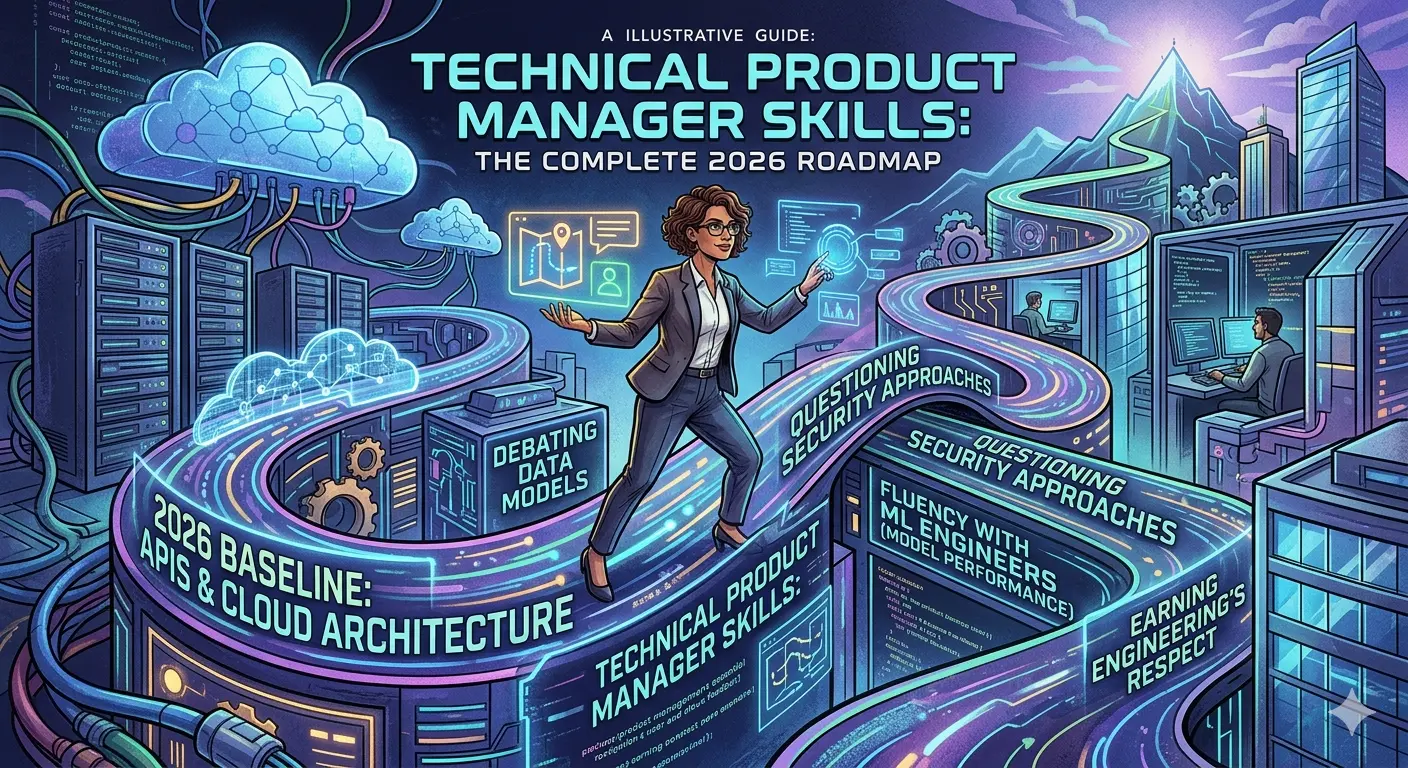
In 2019, knowing what an API was put you ahead. In 2026, that’s baseline. Now you’re expected to understand cloud architecture, debate data models, question security approaches, and speak fluently with ML engineers about model performance.
I’ve watched brilliant non-technical PMs get passed over for promotions. Not because they lacked product skills—they were excellent at roadmaps, user research, and stakeholder management. But they couldn’t earn engineering’s respect in technical discussions.
Meanwhile, I’ve seen technically-inclined PMs accelerate their careers dramatically. Same product skills. Different technical credibility. Vastly different outcomes.
This guide isn’t about becoming an engineer. It’s about becoming a product manager who can hold your own in technical conversations, make better decisions with technical context, and build genuine credibility with your engineering partners.
What “Technical PM” Actually Means
Let’s clear up a misconception. A technical product manager isn’t:
- ❌ Someone who writes production code
- ❌ Someone who makes architectural decisions
- ❌ Someone who reviews pull requests
- ❌ Someone who debugs production issues
A technical product manager IS:
- ✅ Someone who understands technical trade-offs
- ✅ Someone who asks informed questions about architecture
- ✅ Someone who can translate between technical and business concepts
- ✅ Someone who builds trust with engineering through competence
- ✅ Someone who makes decisions with technical context in mind
💡 The Naked Truth: The goal isn’t to become an engineer. The goal is to become the product leader engineers want to work with—not the one they have to work around.
The Seven Core Technical Skills Every PM Needs
After working with dozens of PMs and interviewing hundreds more, I’ve identified seven technical skills that separate technically credible PMs from everyone else.
The Technical PM Skills Framework
┌─────────────────────────────────────────────────────────────┐
│                    TECHNICAL PM SKILLS 2026                  │
├─────────────────────────────────────────────────────────────┤
│                                                             │
│  FOUNDATION SKILLS (Must Have)                              │
│  ├── 1. API Understanding                                   │
│  ├── 2. Database Fundamentals                               │
│  └── 3. Data & Analytics                                    │
│                                                             │
│  MODERN SKILLS (Increasingly Required)                      │
│  ├── 4. Cloud Infrastructure                                │
│  ├── 5. Security & Compliance                               │
│  └── 6. Architecture Patterns                               │
│                                                             │
│  ADVANTAGE SKILLS (Differentiator)                          │
│  └── 7. AI/ML Fundamentals                                  │
│                                                             │
└─────────────────────────────────────────────────────────────┘
How to Use This Framework
Foundation Skills: Non-negotiable. Every PM should understand APIs, databases, and data basics. Without these, you’ll struggle in almost every technical conversation.
Modern Skills: Expected at growing companies. If your product runs on cloud infrastructure (it probably does), you need to understand how that works. Security awareness is increasingly critical.
Advantage Skills: Sets you apart. Not every PM needs AI/ML knowledge, but in 2026, it’s becoming a significant advantage.
Skills Assessment: Where Do You Stand?
Rate yourself honestly on each skill (1-5 scale):
| Skill | 1 (Novice) | 3 (Competent) | 5 (Expert) |
|---|---|---|---|
| APIs | “What’s an API?” | Can read API docs, understand endpoints | Can design API contracts, debate REST vs GraphQL |
| Databases | “What’s a table?” | Understand schemas, can write basic SQL | Can discuss data modeling trade-offs |
| Data/Analytics | Rely entirely on analysts | Can query data, build dashboards | Design metrics, statistical analysis |
| Cloud | Don’t know where our app runs | Understand AWS/GCP basics, server concepts | Can discuss scaling, cost optimization |
| Security | “We have a security team” | Understand auth flows, basic vulnerabilities | Can threat model, lead security reviews |
| Architecture | “Engineers decide that” | Understand monolith vs microservices | Can participate in architecture discussions |
| AI/ML | “It’s magic” | Understand ML basics, model lifecycle | Can work with ML teams effectively |
Scoring:
- 7-14: Foundation needed. Start with APIs and databases.
- 15-24: Growing competence. Focus on modern skills.
- 25-35: Strong technical PM. Consider advantage skills.
Understanding Architecture Without Being an Engineer
Architecture is one of those topics PMs often avoid. “That’s engineering’s job,” they think. But understanding architecture helps you make better product decisions.
The Two Fundamental Architecture Patterns
Monolith: Everything in One Place
┌─────────────────────────────────────┐
│           MONOLITH                  │
│  ┌───────────────────────────────┐  │
│  │  User Interface               │  │
│  ├───────────────────────────────┤  │
│  │  Business Logic               │  │
│  ├───────────────────────────────┤  │
│  │  Data Access                  │  │
│  ├───────────────────────────────┤  │
│  │  Database                     │  │
│  └───────────────────────────────┘  │
│                                     │
│  One codebase, one deployment       │
└─────────────────────────────────────┘
Pros: Simple to develop, easy to debug, straightforward deployments Cons: Hard to scale, changes affect everything, technology lock-in
Microservices: Many Small Pieces
┌─────────────┐  ┌─────────────┐  ┌─────────────┐
│  User       │  │  Payment    │  │  Inventory  │
│  Service    │  │  Service    │  │  Service    │
└──────┬──────┘  └──────┬──────┘  └──────┬──────┘
       │                │                │
       └────────────────┼────────────────┘
                        │
              ┌─────────▼─────────┐
              │   API Gateway     │
              └─────────┬─────────┘
                        │
              ┌─────────▼─────────┐
              │   User Interface  │
              └───────────────────┘

Each service: Independent development, deployment, scaling
Pros: Independent scaling, technology flexibility, team autonomy Cons: Complexity, distributed system challenges, operational overhead
Why This Matters for PMs
When you understand architecture, you can have conversations like:
Scenario: “We need to add real-time notifications.”
Without architecture understanding:
PM: "Can we add notifications?"
Eng: "It's complicated."
PM: "How long will it take?"
Eng: "We'll get back to you."
With architecture understanding:
PM: "For real-time notifications, do we need a new service,
    or can we add it to the existing user service? What's the
    trade-off between adding complexity vs. speed to market?"
Eng: "Good question. We could add it to the user service for
     faster delivery, but it couples notification logic. A new
     service is cleaner but adds operational overhead."
PM: "Let's prototype in the user service first. If notifications
    become complex, we can extract later. What do you think?"
Eng: "Smart approach. Let's do that."
See the difference? You’re not making architectural decisions. You’re facilitating better decisions.
Key Architecture Concepts to Know
| Concept | What It Means | Why It Matters |
|---|---|---|
| Scalability | System handles more load | Affects cost, user experience at scale |
| Availability | System stays up | Affects SLAs, customer trust |
| Latency | Response time | Affects user experience directly |
| Coupling | How dependent components are | Affects change speed, risk |
| Data consistency | How data stays in sync | Affects feature design, user experience |
Data and Analytics: Making Numbers Your Friend
Data skills are perhaps the most immediately useful technical skills for PMs. Being able to answer your own questions without waiting for analysts is a superpower.
The Data Hierarchy of Needs
                    ┌─────────────────────┐
                    │   PREDICTION        │  "What will happen?"
                    │   (ML/Forecasting)  │
                    ┌─────────────────────┐
               ┌────┤   PRESCRIPTION      ├────┐
               │    │   "What should we   │    │
               │    │    do?"             │    │
               │    └─────────────────────┘    │
               │                                │
        ┌──────┴────────────────────────────────┴──────┐
        │               DIAGNOSIS                       │
        │               "Why did it happen?"            │
        └───────────────────────┬───────────────────────┘
                                │
        ┌───────────────────────┴───────────────────────┐
        │               MONITORING                       │
        │               "What's happening now?"          │
        └───────────────────────┬───────────────────────┘
                                │
        ┌───────────────────────┴───────────────────────┐
        │               DATA COLLECTION                 │
        │               "What data do we have?"         │
        └───────────────────────────────────────────────┘
Essential SQL for PMs
You don’t need to be a SQL expert. But being able to write basic queries transforms your workflow.
The 5 queries every PM should know:
-- 1. Count active users
SELECT COUNT(DISTINCT user_id)
FROM user_activity
WHERE activity_date >= '2026-01-01';

-- 2. Group and count (e.g., users by signup source)
SELECT signup_source, COUNT(*)
FROM users
GROUP BY signup_source
ORDER BY COUNT(*) DESC;

-- 3. Join tables (e.g., orders with user info)
SELECT u.email, o.total_amount, o.created_at
FROM users u
JOIN orders o ON u.id = o.user_id
WHERE o.created_at >= '2026-01-01';

-- 4. Calculate averages
SELECT AVG(session_duration_seconds) / 60 as avg_minutes
FROM user_sessions
WHERE session_date = '2026-01-15';

-- 5. Find top performers
SELECT user_id, COUNT(*) as order_count, SUM(total_amount) as total_spent
FROM orders
WHERE created_at >= '2026-01-01'
GROUP BY user_id
ORDER BY total_spent DESC
LIMIT 10;
Metrics That Matter
North Star Metric: The one metric that best captures the value your product delivers to customers.
Input Metrics: Leading indicators you can influence that affect your North Star.
Guardrail Metrics: Things that shouldn’t get worse while you improve other metrics.
Example Framework:
North Star: Monthly Active Users (MAU)

Input Metrics:
├── New user signups
├── Activation rate (users who complete key action)
├── Retention rate (users who return)
└── Referral rate (users who invite others)

Guardrail Metrics:
├── Page load time (shouldn't degrade)
├── Support ticket volume (shouldn't spike)
└── Unsubscribe rate (shouldn't increase)
API Basics Every Product Manager Should Know
APIs are how software talks to software. Understanding APIs helps you understand what’s possible, what’s hard, and what questions to ask.
What APIs Actually Do
Think of APIs like restaurant menus:
- Menu (API documentation): Lists what you can order
- Waiter (API endpoint): Takes your request to the kitchen
- Kitchen (Server): Prepares what you ordered
- Dish (Response): What you get back
The Anatomy of an API Request
REQUEST:
─────────────────────────────────────────────────
GET /api/v1/users/123
Host: api.yourproduct.com
Authorization: Bearer abc123token
─────────────────────────────────────────────────
│       │            │         │
│       │            │         └── Authentication
│       │            └── Resource ID
│       └── Endpoint path
└── HTTP method (GET, POST, PUT, DELETE)

RESPONSE:
─────────────────────────────────────────────────
HTTP/1.1 200 OK
Content-Type: application/json

{
  "id": 123,
  "name": "Jane Smith",
  "email": "jane@example.com",
  "created_at": "2026-01-15T09:30:00Z"
}
─────────────────────────────────────────────────
│           │
│           └── Response body (JSON)
└── Status code (200 = success)
Key API Concepts for PMs
| Concept | What It Means | Product Implication |
|---|---|---|
| REST | Standard API design pattern | Most APIs you’ll work with follow this |
| Authentication | How APIs verify identity | Affects user experience, security |
| Rate Limiting | Max requests per time period | Affects product behavior at scale |
| Versioning | API versions (v1, v2) | Affects compatibility, migration planning |
| Webhooks | API pushes data to you | Enables real-time features |
| GraphQL | Query language for APIs | Alternative to REST, more flexible |
Questions to Ask About APIs
When planning features that involve APIs:
- “What endpoints do we need to support this feature?”
- “Is this a read operation (GET) or a write operation (POST/PUT)?”
- “What authentication does this require?”
- “Are there rate limits that could affect this feature?”
- “What happens if the API call fails?”
Database Fundamentals for Non-Technical PMs
Every product stores data. Understanding how databases work helps you make better decisions about features, performance, and trade-offs.
Types of Databases
Relational Databases (SQL)
- Examples: PostgreSQL, MySQL
- Data in tables with rows and columns
- Strict relationships between data
- Best for: Structured data, transactions, complex queries
NoSQL Databases
- Examples: MongoDB, DynamoDB, Redis
- Flexible data structures
- Horizontal scaling
- Best for: Unstructured data, high volume, simple queries
The Database Decision Framework
┌─────────────────────────────────────────────────────────────┐
│              CHOOSING A DATABASE TYPE                       │
├─────────────────────────────────────────────────────────────┤
│                                                             │
│  Do you need ACID transactions?                             │
│  ├── YES → Relational (PostgreSQL, MySQL)                   │
│  └── NO → Continue                                          │
│                                                             │
│  Is your data structure well-defined?                       │
│  ├── YES → Relational                                       │
│  └── NO → Document store (MongoDB)                          │
│                                                             │
│  Do you need extreme scale (millions of writes/second)?     │
│  ├── YES → NoSQL (DynamoDB, Cassandra)                      │
│  └── NO → Relational is probably fine                       │
│                                                             │
│  Do you need real-time queries on massive datasets?         │
│  ├── YES → Analytics database (ClickHouse, BigQuery)        │
│  └── NO → Standard database works                           │
│                                                             │
└─────────────────────────────────────────────────────────────┘
Common Database Concepts
| Concept | What It Means | Why It Matters |
|---|---|---|
| Schema | Structure of your data | Changes require migration planning |
| Index | Speed optimization for queries | Affects query performance |
| Migration | Structured database change | Needs careful planning |
| Replication | Copying data for reliability | Affects consistency, latency |
| Sharding | Splitting data across servers | Enables scaling |
The Migration Conversation
When engineering says “we need a database migration,” here’s what to discuss:
PM Questions for Database Migrations:

1. What data is changing?
2. What's the rollback plan if something goes wrong?
3. How long will the migration take?
4. Will users experience any downtime?
5. What's the risk if we don't do this migration?
6. Can we do this during low-traffic hours?
Cloud Infrastructure 101 for Product Managers
Most products run on cloud infrastructure (AWS, GCP, Azure). Understanding the basics helps you discuss cost, reliability, and performance.
The Cloud Computing Model
┌─────────────────────────────────────────────────────────────┐
│                    CLOUD SERVICE MODELS                     │
├─────────────────────────────────────────────────────────────┤
│                                                             │
│  SaaS (Software as a Service)                               │
│  Example: Gmail, Salesforce                                 │
│  You use: Just the application                              │
│                                                             │
│  PaaS (Platform as a Service)                               │
│  Example: Heroku, Google App Engine                         │
│  You manage: Your application code                          │
│  Provider manages: Runtime, middleware, OS, infrastructure  │
│                                                             │
│  IaaS (Infrastructure as a Service)                         │
│  Example: AWS EC2, Google Compute Engine                    │
│  You manage: Application, runtime, middleware, OS           │
│  Provider manages: Physical infrastructure                  │
│                                                             │
└─────────────────────────────────────────────────────────────┘
Key Cloud Concepts
Compute: Where your code runs (servers, containers, serverless) Storage: Where your files live (S3, Cloud Storage) Database: Where your data lives (RDS, DynamoDB, Cloud SQL) Networking: How everything connects (VPC, load balancers, CDN) Security: Who can access what (IAM, encryption, firewall rules)
Cost Awareness
Cloud costs can spiral quickly. As a PM, you should understand:
Cost Drivers:
├── Compute: Number of servers × hours running
├── Storage: Amount of data stored
├── Data transfer: Data moving in/out of cloud
├── Database: Instance size, storage, queries
└── Additional services: Monitoring, analytics, etc.

Questions to Ask:
1. "What's our current monthly cloud bill?"
2. "What are our biggest cost drivers?"
3. "How will this feature affect our infrastructure costs?"
4. "Are there optimizations we should prioritize?"
Security and Compliance: What PMs Must Understand
Security isn’t just the security team’s job. Every feature decision has security implications, and PMs need to understand the basics.
The Security Mindset
Think about security in layers:
┌─────────────────────────────────────────────────────────────┐
│                    SECURITY LAYERS                          │
├─────────────────────────────────────────────────────────────┤
│                                                             │
│  1. AUTHENTICATION ("Who are you?")                         │
│     Passwords, SSO, MFA, biometrics                         │
│                                                             │
│  2. AUTHORIZATION ("What can you do?")                      │
│     Permissions, roles, access control                      │
│                                                             │
│  3. DATA PROTECTION ("Is your data safe?")                  │
│     Encryption, masking, backup                             │
│                                                             │
│  4. NETWORK SECURITY ("Can attackers reach us?")            │
│     Firewalls, VPNs, rate limiting                          │
│                                                             │
│  5. APPLICATION SECURITY ("Is our code safe?")              │
│     Input validation, secure coding practices               │
│                                                             │
│  6. MONITORING ("Do we know if something's wrong?")         │
│     Logging, alerts, incident detection                     │
│                                                             │
└─────────────────────────────────────────────────────────────┘
Security Questions for Every Feature
When reviewing features, ask:
- “What data does this feature access? Is it sensitive?”
- “Who should be able to access this feature?”
- “How do we authenticate users for this feature?”
- “What could go wrong if someone misuses this feature?”
- “Are we logging enough to detect problems?”
Compliance Basics
If you work in healthcare (HIPAA), finance (PCI, SOX), or serve EU customers (GDPR), compliance isn’t optional.
| Regulation | What It Covers | Key PM Considerations |
|---|---|---|
| GDPR | EU user data | Consent, data deletion rights, data portability |
| HIPAA | Healthcare data | Access controls, audit logs, encryption |
| PCI DSS | Payment card data | Secure storage, access restrictions |
| SOC 2 | Service organization controls | Security, availability, processing integrity |
Building Technical Credibility with Engineers
Technical skills mean nothing if engineers don’t trust you. Here’s how to build genuine credibility.
The Credibility Framework
┌─────────────────────────────────────────────────────────────┐
│                TECHNICAL CREDIBILITY                        │
├─────────────────────────────────────────────────────────────┤
│                                                             │
│  RESPECT = Competence + Humility + Curiosity                │
│                                                             │
│  Competence:                                                │
│  ├── Know your domain deeply                                │
│  ├── Understand technical concepts                          │
│  └── Make informed decisions                                │
│                                                             │
│  Humility:                                                  │
│  ├── Admit what you don't know                              │
│  ├── Defer to experts on their expertise                    │
│  └── Ask questions, don't dictate solutions                │
│                                                             │
│  Curiosity:                                                 │
│  ├── Ask "why" genuinely                                    │
│  ├── Learn from every interaction                           │
│  └── Show interest in technical challenges                  │
│                                                             │
└─────────────────────────────────────────────────────────────┘
Phrases That Build Credibility
Instead of: “This should be easy, right?” Say: “What’s the technical complexity here? Help me understand.”
Instead of: “Why is this taking so long?” Say: “What’s blocking us? Is there anything I can help remove?”
Instead of: “Just make it work.” Say: “What do you need to make this successful?”
Instead of: “That’s a technical problem.” Say: “Help me understand the technical implications so I can factor them into our planning.”
Red Flags That Kill Credibility
- Pretending to understand when you don’t
- Dismissing technical concerns as “just engineering problems”
- Making promises to stakeholders without consulting engineering
- Micromanaging technical implementation
- Blaming engineering for missed deadlines without understanding root causes
Your 90-Day Technical Skills Plan
Here’s a concrete plan to build your technical skills over the next 90 days.
Days 1-30: Foundation
Week 1: APIs
- Complete a basic API tutorial (Postman has great free courses)
- Read your product’s API documentation
- Try making API calls with Postman or curl
- Understand authentication methods (API keys, OAuth, JWT)
Week 2: Databases
- Complete a SQL basics course (Mode Analytics has a free one)
- Get access to your product’s database (read-only)
- Write your first query to answer a product question
- Understand your database schema
Week 3: Data & Analytics
- Set up access to your analytics tools
- Build a dashboard for a key product metric
- Learn SQL aggregation (COUNT, SUM, AVG, GROUP BY)
- Document your data sources and definitions
Week 4: Integration
- Apply your new skills to a real product question
- Share findings with your team
- Present data without waiting for an analyst
- Get feedback on your technical understanding
Days 31-60: Modern Skills
Week 5-6: Cloud Infrastructure
- Understand where your product runs (AWS, GCP, Azure?)
- Get a high-level overview of your architecture
- Understand cost drivers
- Learn about scaling and reliability
Week 7-8: Security
- Complete a security fundamentals course
- Understand your product’s authentication flow
- Review your product’s compliance requirements
- Practice threat modeling for a new feature
Days 61-90: Deepening
Week 9-10: Architecture
- Map out your product’s architecture
- Understand key architectural decisions
- Participate actively in technical discussions
- Document what you’ve learned
Week 11-12: Integration & Practice
- Lead a technical discussion with confidence
- Present a technical proposal to stakeholders
- Mentor a less technical PM
- Evaluate your progress and set next goals
Resources and Learning Paths
Free Resources
APIs:
- Postman Learning Center (free courses)
- MDN Web Docs - HTTP and APIs
- Your own product’s API documentation
Databases & SQL:
- Mode Analytics SQL Tutorial (free)
- SQLBolt (interactive lessons)
- W3Schools SQL Tutorial
Cloud Infrastructure:
- AWS Training (free digital courses)
- Google Cloud Skills Boost (free tier)
- Azure Learn (free modules)
Security:
- OWASP Top 10 (start here)
- Coursera - Information Security courses (audit for free)
- SANS Cyber Aces (free)
Paid Resources Worth Considering
- Coursera/edX: University-level courses on specific topics
- A Cloud Guru: Comprehensive cloud training
- O’Reilly: Books and video courses on technical topics
- Internal training: Ask your company about learning budgets
The Bottom Line
Technical skills aren’t about becoming an engineer. They’re about becoming a more effective product manager.
When you can hold your own in technical conversations, several things happen:
Engineers trust you more. They see you as a partner, not a source of unrealistic demands.
You make better decisions. Technical context helps you understand trade-offs, risks, and opportunities.
Your career accelerates. Technical PMs are in high demand and command higher salaries.
Product quality improves. You catch issues earlier, plan more realistically, and deliver better outcomes.
The investment is worth it. Start today. Pick one skill. Commit to 30 days of learning. Then build from there.
About the Author
I’m Karthick Sivaraj, creator of The Naked PM. I’ve spent years helping non-technical product managers build the technical credibility they need to collaborate effectively with engineering teams.
I wasn’t always technically proficient. I learned these skills the hard way—through awkward meetings, confused stares from engineers, and a determination to never feel lost in technical discussions again.
Now I help other PMs skip the awkward phase and build technical skills that actually matter.
Connect with me on LinkedIn for weekly insights on product management, technical skills, and career development.
Which technical skill will you tackle first? Share your commitment in the comments—I’d love to hear your plan.
Related Reading:
💬 Join the Conversation